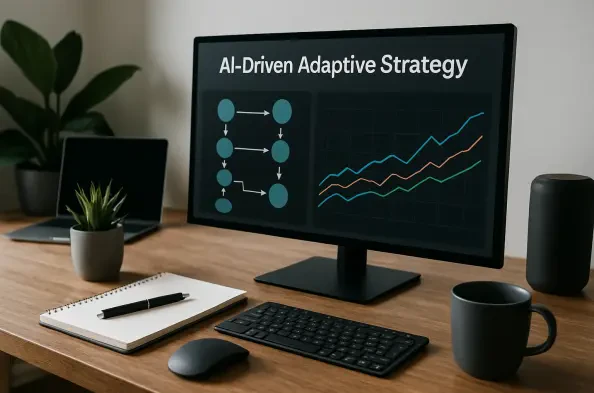
The traditional corporate roadmap, once a symbol of executive discipline and long-term vision, has transitioned from a foundational asset into a dangerous structural liability in a world of non-linear technological acceleration. While previous digital shifts in cloud and mobile computing allowed for predictable, input-driven planning, the current trajectory of artificial intelligence has rendered the old “systems of certainty” obsolete. Today, the most successful organizations are moving away from rigid three-year goals and toward a “radar” philosophy. This review examines the shift toward AI-driven adaptive strategies, where the ability to sense and respond in real-time outweighs the ability to predict a singular, static future.
The Paradigm Shift: From Roadmaps to Radar Systems
The move from linear strategic planning to AI-augmented adaptive systems represents a fundamental change in how leadership perceives risk and resilience. In the past, frameworks like OKRs and SLAs provided a comforting, albeit often artificial, sense of control by assuming a stable market environment. However, the current rate of AI advancement means that the ground shifts not by the year, but by the week. By adopting a radar philosophy, organizations prioritize environmental sensing over rigid adherence to a pre-defined path, allowing them to detect subtle market signals before they become disruptive tidal waves.
This shift is particularly relevant because it acknowledges that “certainty” is no longer a viable product of strategy. Where traditional planning sought to eliminate ambiguity, adaptive systems embrace it as a source of competitive advantage. Companies that can process information faster and pivot with less friction are inherently more resilient than those bound by a “system of certainty” that cannot account for the volatility of an AI-led economy. This transition marks the end of the roadmap as a definitive guide and its rebirth as a fluid, living document.
Core Architectural Components of Adaptive Strategy
Multipath Simulation and Reasoning Models
At the heart of this strategic evolution lies the technical transition from single-path forecasting to multipath simulations powered by high-level reasoning models. Unlike traditional scenario planning, which often relegated “what-if” queries to the margins, modern AI allows enterprises to map thousands of plausible futures simultaneously. This approach lowers the cost of complex modeling, enabling strategy teams to identify “no-regrets” moves—actions that remain strategically sound regardless of which specific future manifests.
Short-Loop Agile Iteration Engines
Integrating Agile methodologies into the highest levels of corporate strategy allows for the breakdown of massive, multi-year initiatives into self-contained, iterative components. These short feedback loops are essential for maintaining organizational sensitivity to rapid shifts in regulation or consumer behavior. By executing in “sprints” rather than marathons, a company can adjust its tactical orientation without dismantling its entire operational core. This performance metric—the speed of the feedback loop—is becoming a primary indicator of a firm’s health.
Networked Intelligence and Distributed Hierarchy
The architecture of modern strategy is also moving away from top-down information silos toward distributed networks where AI serves as a universal signaling mechanism. In this model, AI acts as an always-on internal consultant, providing high-level analytical capabilities to every layer of the organization. This democratization of intelligence ensures that ground-level teams have the same strategic clarity as the executive suite, allowing for decentralized decision-making that is faster and more contextually accurate than traditional hierarchical direction.
Modern Trends in Strategic AI Implementation
A significant emerging trend is the application of venture capital logic to general corporate decision-making. Leaders are increasingly valuing portfolio optionality over fixed decisiveness, recognizing that the greatest risk in a high-velocity market is being “locked in” to a failing hypothesis. This cultural shift rewards pattern-matching and real-time sensitivity, transforming the executive role from a decider of paths to a manager of possibilities.
Moreover, the democratization of sophisticated economic modeling is leveling the playing field. Capabilities that were once the exclusive domain of tech giants or elite consulting firms are now accessible to mid-sized enterprises. This shift allows smaller players to perform rigorous stress-testing and competitive analysis at a fraction of the historical cost, forcing established incumbents to accelerate their own adoption of adaptive tools to maintain their market position.
Real-World Applications and Sector Impact
In the hardware and digital services sectors, companies like HP have begun transitioning toward lifecycle-driven models that use AI to anticipate customer needs and pivot service offerings mid-cycle. Similarly, in e-commerce and logistics, internal teams of AI economists now function as the primary signaling bodies for tactical adjustments. These teams use real-time data to adjust supply chains and pricing models, effectively replacing the “gut feeling” of traditional management with data-driven sensitivity.
High-stakes industries are also leveraging AI as a pre-market stress-testing tool. By simulating various regulatory hurdles and competitive reactions before a product launch, firms can surface blind spots that would have previously resulted in costly failures. This application of AI as a “red team” for strategy helps ensure that when a company does commit resources, it does so with a much higher probability of sustained relevance in a volatile environment.
Technical Limitations and Regulatory Hurdles
Despite its potential, AI remains a pattern-finding engine rather than an infallible oracle. The danger of data bias and hallucinations in strategic planning is a significant risk; if the underlying data reflects a stagnant past, the AI may fail to recognize a truly novel future. Organizations must remain vigilant against “automation bias,” where leaders defer to algorithmic outputs without applying the necessary human discernment to evaluate the logic behind the suggestion.
Furthermore, market obstacles like organizational inertia continue to hinder progress. Dismantling established “systems of certainty” requires more than just new software; it requires a total overhaul of corporate culture and incentive structures. Regulatory hurdles also loom large, as governments struggle to keep pace with the speed of AI-driven business pivots, potentially creating a mismatch between a company’s adaptive capabilities and its legal compliance requirements.
The Future of AI-Augmented Strategic Planning
Looking forward, the role of AI is expected to evolve from an efficiency tool into a core “thinking partner” within the executive suite. We are likely to see the emergence of autonomous strategy agents capable of executing real-time pivots—such as reallocating marketing spend or adjusting production schedules—without human intervention. This would represent the ultimate realization of the adaptive strategy, where the delay between sensing a market shift and responding to it is reduced to near zero.
However, this high-velocity environment may lead to a “permanently volatile” global market. If every major player adopts these adaptive systems, the resulting feedback loops could create a business landscape that moves so quickly it becomes difficult for human-led institutions to maintain stability. The long-term impact will likely be a radical redefinition of global market competition, where “strategy” is no longer about winning a game, but about staying in the game as it constantly changes its rules.
Comprehensive Assessment of Adaptive Strategy
The transition toward AI-driven adaptive strategy proved to be an essential survival mechanism for the modern enterprise. By prioritizing fluid simulations over static roadmaps, organizations successfully mitigated the risks of non-linear market shifts. The technical integration of multipath reasoning and shortened feedback loops allowed leaders to maintain a “radar” view of their industries, ensuring that sensitivity to change became the new standard for corporate discipline. While AI provided the high-velocity analytical engine, human discernment remained the necessary rudder for navigating ethical and creative complexities. Ultimately, the adoption of these systems moved business planning from a ritual of prediction to a continuous process of evolution, ensuring that the most resilient firms were those that viewed uncertainty not as a threat, but as an opportunity for rapid adaptation.