Small business owners often believe that a quick click on the “Empty Recycle Bin” button is the final word in digital hygiene, yet the legal reality is far more complex. A new 18-page regulatory guide clarifies that personal information stored in spreadsheets, chat apps, and backups remains subject to strict deletion protocols regardless of a company’s size. Released by the State Commissioner for Data Protection of Saxony-Anhalt in September 2026, this document serves as a wake-up call for entities that have historically treated data deletion as an afterthought or a simple housekeeping task. The regulator emphasizes that the General Data Protection Regulation (GDPR) requires a level of permanence and non-recoverability that standard operating system functions simply cannot provide. By shifting the focus from a casual user habit to a structured corporate policy, the guide forces small and medium-sized enterprises (SMEs) to confront the technical debt of their legacy storage habits. This directive is not merely a suggestion; it represents a formal interpretation of the storage limitation principle, signaling that regulators are losing patience with organizations that fail to implement professional-grade data sanitation routines despite having years to adapt to the current privacy landscape.
1. Foundations of a Data Inventory
To establish a compliant data deletion policy, a business must first engage in a rigorous process of pinpointing data usage. This involves determining exactly which personal details are being handled—ranging from basic contact information like names and email addresses to more sensitive identifiers such as tax IDs or employee performance records—and articulating the specific reasons for doing so. Under the GDPR, every piece of personal data must be linked to a lawful purpose, such as the fulfillment of a contract, legal obligation, or explicit consent. By documenting these purposes clearly, an organization creates the necessary legal foundation for its eventual deletion. This initial step is critical because it prevents the common pitfall of “data hoarding,” where companies keep information indefinitely under the vague assumption that it might be useful in the future. The Saxony-Anhalt guide makes it clear that without a defined purpose, storage is inherently unlawful, and therefore, the first duty of the controller is to justify every data point they possess. This process requires a cross-departmental audit, involving human resources, marketing, and sales, to ensure that no obscure database or customer list is left out of the official record-keeping effort.
Once the usage has been identified, the next requirement is to map storage sites with granular precision. A business must create a detailed list of every digital and physical location where information is kept, moving beyond obvious choices like central databases to include less visible repositories. This includes identifying data within backup systems, email inboxes, local desktop folders, and even unstructured formats like chat messages in apps like WhatsApp or Signal. Many small firms often overlook “shadow IT”—the various cloud services or personal devices used by employees without formal authorization. The regulator warns that the presence of personal data on a staff member’s smartphone or an unmonitored cloud drive does not exempt that data from GDPR requirements. Mapping these sites requires a thorough technical scan and employee interviews to uncover where files might be lurking. By building a comprehensive inventory that spans from physical filing cabinets to document repositories on cloud file servers, the organization ensures that its deletion protocols can be applied universally. This mapping serves as the blueprint for the entire sanitation strategy, allowing the company to demonstrate to auditors that they have full visibility into their data environment and can execute a deletion request across all possible touchpoints without leaving residual fragments behind.
2. Accountability and Structural Procedures
Defining roles within the organization is a prerequisite for a functioning deletion policy, which is why the regulator stresses the need to assign responsibilities early in the process. A business must establish exactly who is in charge of removing data, as well as the specific timing and methods used for different categories of information. In a small firm, this might fall to the office manager, an IT lead, or the business owner, but the key is that the responsibility must be formally designated rather than left to chance. This structural approach ensures that deletion becomes a scheduled operational task rather than a reactive one. Without clear ownership, data tends to accumulate as employees assume someone else will handle the cleanup. By assigning these duties, the company creates a chain of accountability that can be tracked and audited. This also involves training the designated personnel on the technical tools required for permanent erasure, ensuring they understand the difference between hiding a file and destroying it. The objective is to weave data management into the fabric of daily operations, ensuring that the lifecycle of every piece of information is managed by a specific individual with the authority and knowledge to act when retention periods expire.
To support these roles, the guide mandates that businesses formalize internal rules by drafting written instructions for all employees. These instructions should detail how to process deletion requests from outsiders and how to maintain meticulous records of completed erasures. A verbal agreement or an informal understanding among staff is insufficient to meet the documentation requirements of the GDPR. Formalized rules act as a manual for the workforce, providing clear steps on what to do when a customer asks to be forgotten or when a project reaches its legal expiration date. These internal guidelines should also cover the reporting lines—who to inform once a deletion is carried out and where to log the confirmation of the act. Having these rules in writing protects the business during regulatory inspections, as it proves that the company has established a systematic approach to data protection. Moreover, it ensures continuity; if a key staff member leaves the company, the processes for data deletion remain documented and accessible to their successor. This institutionalization of data hygiene prevents the loss of compliance during organizational transitions and reinforces a culture where the privacy of individuals is treated as a high-priority business process.
3. The Mechanics of the Deletion Catalog
Central to the regulator’s framework is the creation of a deletion catalog, which introduces a vital distinction between how long data must be kept and how quickly it must be removed. This begins with determining the mandatory storage duration, which is the minimum timeframe data must be kept to satisfy legal, commercial, or tax laws. For example, German tax regulations typically require invoices and accounting records to be retained for 10 years, while other business correspondence may only require six. During this period, the data is protected from deletion because the law prioritizes the preservation of evidence for audits or legal disputes. However, the guide warns businesses not to use these lengthy periods as an excuse for general data retention. Each category of data must have its own justified period; an employee’s performance review does not necessarily share the same retention necessity as their payroll records. By meticulously listing these durations in a catalog, a small business can navigate the conflicting demands of different statutes, ensuring they do not delete information too early while also identifying the exact moment when the legal justification for holding that data finally evaporates.
The second half of this catalog is the removal window, which represents the brief period immediately following the storage deadline during which the data must be physically or digitally eliminated. The Saxony-Anhalt regulator emphasizes that once a retention period expires, the obligation to delete becomes active. A removal window is a short, reasonable processing time—often ranging from a few days to a month—granted to the business to perform the actual destruction of the data. It is not an extension of the storage period but rather an organizational grace period to allow for batch processing or manual verification. The guide suggests that businesses define these windows clearly in their policy to avoid “accidental retention.” For instance, if a newsletter subscription is canceled, the removal window for that email address might be set to seven days. By formalizing this window, companies move away from a chaotic “delete when we have time” mentality toward a disciplined schedule. This ensures that personal data does not linger in systems longer than absolutely necessary, directly supporting the storage limitation principle. The catalog serves as a master schedule, telling the responsible officers exactly what needs to be purged and by when, leaving no room for ambiguity or procrastination.
4. Managing Initial Deletion Requests
When an individual contacts a business to exercise their right to erasure, the first step in the regulator’s eight-part protocol is to log the inquiry immediately. This documentation must happen as soon as the request arrives, whether it comes through an email, a phone call, or a face-to-face interaction. The log should capture the date of the request, the name of the requester, and the specific data they wish to have removed. This is not just a matter of good organization; it is a legal necessity to ensure a paper trail exists for future audits or in case the individual disputes the company’s handling of their data later. Regulators often start their investigations by looking at these logs to see if the company responded within the mandated one-month timeframe. For a small business, a simple spreadsheet or a dedicated folder in a document management system can serve this purpose, provided it is kept secure and updated in real-time. By logging every interaction, the company demonstrates that it takes its obligations seriously and has a reliable system for tracking the lifecycle of every privacy-related request it receives.
Following the initial log, the organization must delegate the task to a specific staff member who has the authority to handle sensitive information. The guide recommends handing the request to a person such as an office manager, a data protection officer, or a senior accounting professional. This step ensures that the request does not get lost in a general inbox or ignored by a staff member who lacks the training to process it. Delegation also involves setting a clear internal deadline, keeping in mind that the clock starts ticking the moment the request is received. The assigned person becomes the point of contact for the data subject and is responsible for coordinating with different departments—such as IT for server deletions or HR for personnel files—to ensure a comprehensive response. This centralized management of requests prevents fragmented or incomplete erasures, which are a common cause of regulatory fines. By having a clear line of responsibility, the business can act swiftly and decisively, ensuring that the legal rights of the individual are respected without disrupting the broader flow of company operations.
5. Verification and Legal Assessment
Before any data is actually purged, the regulator mandates a crucial security step: confirming the requester’s identity. This check is necessary to ensure that the person asking for the deletion is actually the data subject or their legally authorized representative. Without this verification, a company risks accidentally deleting data on behalf of an imposter, or worse, disclosing sensitive information to the wrong person during the process of confirming what data is held. The guide suggests requesting reasonable proof, such as a copy of an ID with sensitive parts redacted or a verification of the person’s address, especially if the request comes from an unknown email address or a phone number not on file. However, this process must be proportionate; businesses should not demand excessive documentation that creates an unnecessary barrier to the individual’s rights. Once identity is confirmed, the documents used for verification should themselves be deleted immediately. This step acts as a firewall, protecting the integrity of the company’s data and ensuring that the right to erasure is exercised only by those who truly possess it.
Once identity is established, the business must evaluate the claim to determine if the request is valid under the law. Not every request for deletion must be granted immediately; the GDPR provides specific grounds for erasure, such as when the data is no longer needed for its original purpose or when the individual withdraws the consent they previously gave. The evaluator must check if there are overriding legal reasons to keep the data, such as an ongoing contract, a statutory retention duty, or the need to defend against potential legal claims. This assessment requires a nuanced understanding of both privacy law and the specific regulations governing the business’s industry. If the data is still required for an active contract, for instance, the request might be denied or partially granted. The Saxony-Anhalt guide encourages businesses to document this evaluation process thoroughly, noting the specific articles of the GDPR that justify the decision. This creates a defensive record that can be presented to a regulator if the individual files a complaint. By performing a rigorous legal assessment, the company ensures it remains compliant with all its legal obligations, balancing the individual’s right to privacy with the organization’s duty to maintain necessary records.
6. Execution and Documentation Protocols
In cases where a business cannot delete data because of conflicting legal requirements, the regulator provides a specific alternative: deny the request but “block” the data. If the information must be kept for tax audits or legal defense, the company must refuse the immediate deletion but inform the person exactly why the data is being retained in a restricted state. Blocking means that the data is no longer used for daily operations, marketing, or general processing; it is essentially put into “deep storage” where it is only accessible for the specific legal reason that prevented its erasure. This state must be clearly communicated to the data subject, along with the date when the legal impediment is expected to end and the data will finally be deleted. This compromise allows the business to satisfy the tax office while still respecting the spirit of the data subject’s request by limiting the data’s visibility. The guide highlights that blocking is a critical tool for SMEs, as it provides a clear path forward when privacy rights and statutory retention periods collide, ensuring that no laws are broken in the pursuit of compliance.
When a request is valid and no legal impediments exist, the organization must perform the removal without unnecessary delay. This means the data must be physically or digitally eliminated across all systems identified in the initial mapping process. It is not enough to simply delete the user account; every backup, spreadsheet, and chat log containing the person’s identifiable information must be addressed. The guide clarifies that for electronic records, this should involve overwriting the data or using specialized software tools that make recovery impossible. Once the deletion is complete, the business must send a formal confirmation to the individual, informing them that their data has been removed. This confirmation serves as the final act of the transaction and provides the data subject with peace of mind. For the business, it marks the end of its legal responsibility for that specific data point. By executing the removal thoroughly and promptly, the company minimizes its risk profile and demonstrates a high level of technical competency in managing the personal information of its clients and employees.
7. Finalizing the Erasure Process
The penultimate step in the regulator’s protocol is to archive the process itself. Even after the data has been deleted, the business must save a record of the entire interaction to protect itself in the event of a future dispute. This archive should include a copy of the initial request, the results of the identity verification, the legal evaluation that was performed, and a log of the specific actions taken to resolve the inquiry. Critically, the guide advises that this archive should not contain the original personal data that was deleted; rather, it should document the metadata of the process—the fact that a request was handled and the date it was completed. This distinction is vital because keeping the deleted data in the archive would defeat the purpose of the erasure. Having a robust archive of these interactions allows a business to prove to data protection authorities that it has an established, repeatable, and legal process for handling privacy rights. It transforms a potentially messy legal situation into a well-documented business transaction, providing the transparency that modern privacy regulators demand from companies of all sizes.
The final step in the chain is to inform third parties about the deletion. Under Article 19 of the GDPR, if a business has shared the individual’s data with partners, cloud providers, or consultants, it has a duty to instruct those third parties to delete the information as well. This is often the most challenging part of the process for small businesses, as it requires tracking the flow of data outside the organization’s direct control. The Saxony-Anhalt guide emphasizes that this obligation is not optional; businesses must reach out to their tax advisors, marketing agencies, and software-as-a-service providers to ensure the erasure is universal. Many modern digital platforms now include automated tools to facilitate these requests, but in other cases, it may require a manual email or a phone call. By ensuring that third parties also purge the data, the company prevents the person’s information from “resurfacing” later through a partner’s system, which could lead to significant legal liability. This holistic approach ensures that the right to erasure is effective not just within the company’s walls, but across the entire ecosystem where the data was once processed.
8. Technical Standards for Electronic Records
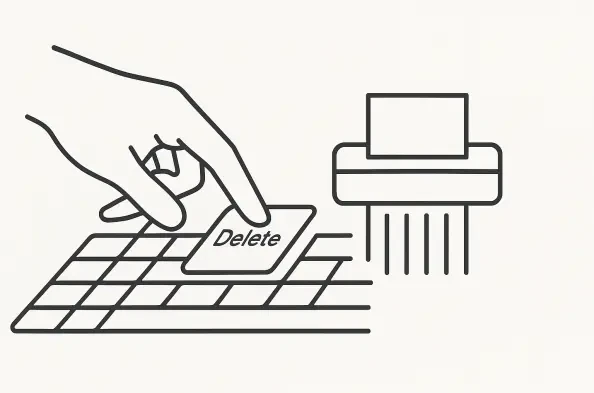
One of the most striking warnings in the new guide concerns the technical inadequacy of standard desktop habits: simply moving a file to the “Trash” or “Recycle Bin” does not meet the requirements for legal deletion. The regulator points out that these functions only remove the pointer to the file, leaving the actual data on the hard drive until it is eventually overwritten by other information. In many cases, these “deleted” files can be recovered with minimal effort using free software, which means the personal data has not actually been erased according to GDPR standards. To achieve compliant deletion, businesses are instructed to use automated software tools specifically designed to overwrite files. These tools write random patterns of bits over the original data, ensuring that it cannot be reconstructed even with forensic tools. For small businesses, this may require updating their internal IT policies to ensure that staff are using the correct procedures rather than relying on the deceptive simplicity of the operating system’s built-in trash functions.
Overwriting is presented as the gold standard for digital sanitation because it addresses the physical reality of how data is stored on magnetic or flash media. The guide suggests that modern business software, such as Customer Relationship Management (CRM) or Enterprise Resource Planning (ERP) systems, often have these secure deletion functions built-in, but they must be properly configured and activated. When a record is “deleted” in a professional database, the system should ideally perform a secure wipe or at least ensure the data is immediately inaccessible and slated for rapid overwriting. The regulator’s emphasis on this technical detail serves as a reminder that privacy compliance is as much a technical challenge as it is a legal one. Businesses that fail to understand the underlying technology of their storage devices risk a “false sense of security,” where they believe they are compliant while actually leaving a trail of recoverable personal data behind. By adopting professional overwriting standards, an organization effectively closes the door on data leaks and ensures that its commitment to privacy is backed by robust technical execution.
9. Physical Disposal and Backup Security
The guide does not limit itself to digital files, providing specific standards for the disposal of paper records which remain a staple in many small offices. When sensitive documents such as medical records, personnel files, or signed contracts need to be destroyed, the regulator mandates the use of a document shredder that meets at least the P-3 security level under the DIN 66399 standard. For records requiring special protection, such as those containing health data, a P-4 or higher level is strongly preferred. These higher security levels ensure that the paper is cut into fragments so small that the information cannot be reassembled. The guide warns against simply tossing intact documents into a general recycling bin, as this is considered a significant data breach. For businesses that use external shredding services, the regulator insists on a formal data processing agreement to ensure the service provider adheres to these same security standards. This focus on physical security ensures that the “paper trail” is as carefully managed as the digital one, preventing unauthorized access to discarded information.
A particularly complex area addressed by the guide is the management of backup systems, where individual files are often bundled into large, monolithic archives that are difficult to edit. Because it is often technically impossible to pluck a single person’s data out of a backup without compromising the entire archive, the regulator suggests the use of “block lists.” A block list is a record of people whose data has been deleted from the live system, ensuring that if the system is ever restored from an old backup, the deleted data is not accidentally brought back into the production environment. This organizational control acts as a safety net, maintaining the integrity of the erasure even after a technical failure or system recovery. The guide also notes that backups themselves should be regularly overwritten or rotated so that old data eventually disappears through the natural cycle of the backup policy. By combining technical rotation with administrative block lists, small businesses can solve the “backup dilemma” and ensure that their deletion promises remain valid even in the face of complex IT restoration scenarios.
10. Continuous Compliance and Auditing
Data protection is not a “set it and forget it” task, which is why the Saxony-Anhalt guide demands that deletion policies undergo annual maintenance and review. At least once a year, a business should audit its inventory and protocols to account for new software, changes in the law, or new types of data collection. This review should ask whether the defined retention periods are still accurate and if the technical tools being used are still considered state-of-the-art. For example, if a company moves from local servers to a cloud-based CRM, its deletion procedures will likely need a complete overhaul to account for the provider’s specific tools. Regular audits also provide an opportunity to refresh staff training, ensuring that new employees are aware of the rules and that long-term staff haven’t slipped back into old, non-compliant habits. By treating the deletion policy as a living document, a small business can stay ahead of the evolving privacy landscape and minimize the risk of being caught off-guard by a regulatory change or a new technical vulnerability.
The risks of neglecting these updates are illustrated by recent enforcement cases where regulators have issued significant fines for mishandled requests. In 2026, for example, the French regulator CNIL fined a consultancy 300,000 euros after it failed to process hundreds of erasure requests properly, often leaving the individuals with no response at all. Similarly, the Italian authority took action against a data broker for failing to respect the rights of individuals whose contact information was being sold. These cases prove that regulators are no longer just looking at large tech giants; they are actively auditing the practices of smaller firms and service providers. For a small business, a five-figure fine can be devastating, making the cost of implementing a proper deletion policy a wise investment in the company’s survival. The Saxony-Anhalt guide provides the roadmap to avoid these pitfalls, framing compliance not just as a legal burden, but as a fundamental part of professional business ethics in the digital age. By following these structured guidelines, SMEs can protect themselves from litigation and build lasting trust with their stakeholders.
11. Strategic Implementation for Small Businesses
To move toward full compliance, successful organizations adopted a proactive stance that treated data hygiene as a recurring operational cycle rather than a one-time fix. They integrated data protection into the very design of their internal workflows, ensuring that every new software acquisition or business process was vetted for its deletion capabilities from the outset. Rather than waiting for a regulatory audit or a formal complaint, these businesses conducted regular internal reviews and staff training sessions to reinforce the importance of proper data destruction. They also established a culture of documentation where every action, from shredding a paper document to wiping a hard drive, was logged with precision. By treating the Saxony-Anhalt guide as a minimum baseline, companies positioned themselves to handle future shifts in privacy law with greater agility. These steps were taken not only to avoid penalties but to streamline data storage costs and improve overall system performance by removing redundant information.
Looking ahead, the focus shifted toward the automation of these processes to minimize human error and ensure that retention periods were enforced without manual intervention. Businesses implemented automated triggers within their databases to alert managers when data was approaching its removal window, allowing for timely and efficient purges. These actions transformed data protection from a legal burden into a competitive advantage, as clients and partners increasingly favored companies that could demonstrate a high level of digital maturity and respect for individual privacy rights through verified erasure protocols. The lessons learned from the 2026 guidelines provided a foundation for more sophisticated information governance, helping firms navigate the complexities of international data transfers and emerging artificial intelligence regulations. Ultimately, the transition to rigorous deletion standards proved that even the smallest organization could achieve a high level of privacy excellence when provided with clear, actionable frameworks and the technical motivation to move beyond the recycle bin.