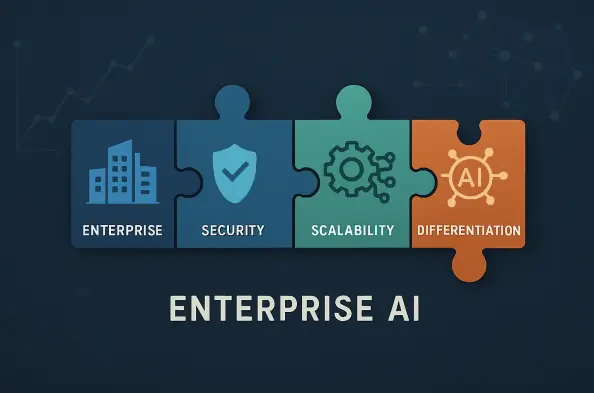
The initial widespread excitement surrounding the raw power of large language models is giving way to a more pragmatic and strategic understanding of how artificial intelligence creates lasting business value. As generative AI models become increasingly powerful and accessible, the race for a competitive advantage is shifting from possessing the best algorithm to implementing it most effectively. This analysis explores the emerging trend where true, defensible AI differentiation for enterprises is found not in the model itself, but in how deeply it is integrated into the unique fabric of the business. The three core pillars driving this shift—business context, user experience, and internal distribution—are becoming the new cornerstones of a successful AI strategy.
The Evolving Landscape From Model Supremacy to Integration Strategy
The Commoditization of Raw AI Capability
While advanced foundation models represent a disruptive technological leap, their increasing availability through APIs and open-source platforms is steadily turning raw intelligence into a commodity. This widespread access means that simply having a powerful model is no longer a sufficient competitive moat. The focus for technology leaders is rapidly shifting from the abstract potential of an algorithm to its practical, operational value within the organization.
The primary concern for CIOs is no longer which model to choose, but rather why some AI initiatives create lasting value while others stall after a promising pilot. This question signals a market maturation where sustainable advantage comes from the thoughtful application of the technology, not just from access to it. The most forward-thinking organizations recognize that the true battleground for AI supremacy is in the execution of a cohesive integration strategy.
Real-World Application Where Value is Truly Created
Leading enterprises are demonstrating that differentiation comes from grounding AI in proprietary systems and workflows. This is evident in the creation of AI assistants that fluently understand a company’s unique operational logic, internal jargon, and established business processes. These systems move beyond generic responses to provide highly relevant, context-aware support that is impossible to replicate with off-the-shelf solutions.
Furthermore, a significant trend is the development of specialized models fine-tuned on internal data, which consistently outperform larger general-purpose models on specific, high-value tasks. The most impactful implementations go a step further by embedding these AI-powered features directly into the core software that employees use daily. By making the technology an invisible and indispensable part of the existing workflow, businesses are transforming AI from a novel tool into a foundational element of their operational backbone.
The Core Pillars of Defensible AI Differentiation
Pillar 1 Grounding AI in Deep Business Context
The effectiveness of any enterprise AI is directly proportional to its understanding of the company’s internal world. Foundation models trained on the vast expanse of public internet data often produce “confidently incorrect” responses when faced with private data and unique business rules. These models lack the nuanced context of an organization’s operational reality, leading to outputs that can be misleading or untrustworthy.
True differentiation emerges from connecting AI to a “ground truth” layer, often found within modern data orchestration systems. These platforms generate a rich stream of up-to-date, accurate metadata about business operations—which data sources are reliable, how business rules are applied, and which processes are currently active. This operational metadata provides the AI with a firm foundation in reality, ensuring its outputs are not just plausible but verifiably accurate and relevant.
By grounding AI in this proprietary context, an organization transforms a generic tool into a bespoke intelligence system. The AI’s ability to reason based on the organization’s unique data landscape becomes a powerful, defensible asset. This deep integration with the company’s operational fabric is one of the clearest sources of sustainable competitive advantage in the current AI landscape.
Pillar 2 Designing for Trust and User Experience
An AI model, no matter how powerful, is merely infrastructure; the employee’s experience is with the entire system built around it. For AI to evolve from an experimental tool into an essential collaborator, it must be designed with trust and usability at its core. According to industry analysis from firms like Forrester, sustainable AI adoption hinges on establishing this fundamental trust through deliberate and thoughtful design choices.
This is achieved by seamlessly integrating AI into the existing “flow of work,” allowing employees to access its capabilities without disrupting their established routines. Furthermore, trust is cultivated through transparency and user control, such as providing clear audit trails for AI-generated information, establishing intuitive user feedback loops, and defining clear escalation paths for when the AI’s output is incorrect or insufficient.
Ultimately, a well-designed user experience transforms a powerful model from an unreliable novelty into an indispensable partner. The same underlying technology can be perceived as either a frustrating black box or a reliable assistant, with the difference determined entirely by the thoughtfulness of its user-facing design and the operational behaviors that cultivate trust over time.
Pillar 3 Driving Impact Through Internal Distribution and Adoption
The most successful enterprise AI implementations achieve scale by meeting employees where they already work. Rather than forcing users to adopt entirely new applications, the AI appears as a new, enhanced capability within familiar tools like email clients, messaging platforms, or core business systems. This strategic approach dramatically lowers the barrier to adoption by avoiding the need for significant behavioral change, which is often a primary obstacle for new technology rollouts.
By integrating directly into trusted and established workflows, AI feels like a natural and welcome addition, boosting productivity without causing disruption. This broad, organic usage also generates an invaluable feedback loop, providing clear signals about which AI features are most effective and in demand. This allows development teams to refine the systems based on real-world usage patterns rather than theoretical assumptions.
This distribution strategy ensures that AI becomes part of the default way work gets done, thereby embedding its value across the entire organization. The goal is to move beyond isolated pilot projects and achieve a pervasive, enterprise-wide impact, making AI an integral and foundational component of daily operations.
The Future Outlook Architecting Integrated and Governed AI Ecosystems
The Strategic Rise of Specialized Models
The future of enterprise AI lies not in a single, monolithic model but in a diverse and interconnected ecosystem of capabilities. A key trend driving this shift is the superior performance of smaller, specialized models that are fine-tuned on a company’s proprietary data for specific tasks. These models are often faster, more cost-effective, and more accurate for their designated purpose than their larger, general-purpose counterparts.
This development underscores a critical strategic realization: an organization’s internal data and operational metadata are its most significant assets for creating defensible, high-performing AI systems. This proprietary data is the raw material for training specialized models that can provide a unique competitive advantage that cannot be purchased or replicated by competitors relying on public models.
The Critical Role of Governance and Risk Management
As AI becomes more deeply embedded in core business operations, the need for robust governance and risk management becomes paramount. Following established frameworks like the NIST AI Risk Management Framework, the focus for enterprises is on establishing clear lines of responsibility, ensuring the full traceability of AI-driven decisions, and proactively managing the associated risks.
The central challenge for CIOs is to build systems that are not only powerful but also reliable, secure, and trustworthy at scale. A failure in governance can quickly undermine even the most technologically advanced AI initiatives, eroding trust and exposing the organization to significant operational and reputational risk. Consequently, a mature governance posture is no longer an afterthought but a prerequisite for achieving a sustainable, long-term advantage with AI.
Conclusion Building a Lasting Competitive Edge with AI
The source of long-term AI differentiation was found to have migrated from the model itself to the integrated systems that gave it context, usability, and scale. Lasting competitive advantage was built upon three distinct but interconnected pillars: grounding AI in deep and proprietary business context, wrapping it in a trustworthy and intuitive user experience, and seamlessly distributing it into existing employee workflows.
For enterprise leaders, the strategic imperative became clear: the focus shifted from merely procuring AI tools to architecting a cohesive and integrated AI ecosystem. The ultimate goal was not just to prove that AI worked, but to build a tailored, durable, and proprietary advantage that competitors could not easily replicate, thereby securing a definitive edge in an increasingly intelligent marketplace.