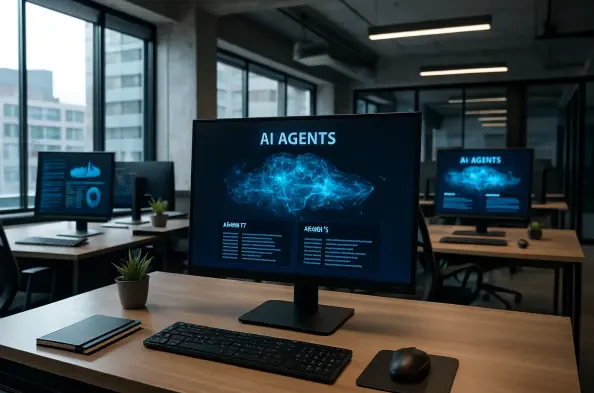
The quiet hum of servers across the enterprise now conceals a rapidly expanding, unseen workforce of autonomous AI agents, each operating with its own logic and data access, often entirely unknown to central IT. This burgeoning digital population, intended to drive innovation, is creating an unprecedented challenge for governance and security. As organizations race to deploy artificial intelligence, they are inadvertently fostering a complex, fragmented ecosystem that threatens to undermine the very efficiency it was meant to create. The critical question for today’s CIOs is no longer if they will use AI, but whether they can maintain control over what they have already built.
Your AI Agents Are Multiplying; Do You Know Where They Are?
For technology leaders, the assumption of having a complete inventory of enterprise software assets is foundational; however, the rise of decentralized AI development has shattered this certainty. Business units, eager to innovate, are independently deploying agentic solutions on various platforms, creating a hidden layer of technology that operates outside the purview of traditional IT governance. This proliferation means that for every officially sanctioned AI project, several others may be running in the shadows, consuming resources, accessing sensitive data, and operating without oversight.
This lack of visibility presents a direct challenge to strategic planning and risk management. Without a comprehensive understanding of where these agents are, what they do, and which data sources they connect to, leaders are making decisions in the dark. The risk of redundant effort, conflicting workflows, and unpatched security vulnerabilities grows with every uncatalogued agent, turning a powerful tool for progress into a potential source of organizational chaos and liability.
The High Cost of Anarchy: Defining Agent Sprawl and Shadow AI
The core of this emerging problem is “agent sprawl,” a condition where AI agents are deployed in a fragmented, siloed, and often redundant manner across an organization. When a marketing team builds a customer-service agent on one platform while the sales team builds a similar one on another, the result is duplicated costs, inconsistent customer experiences, and operational inefficiencies. This fragmentation prevents the enterprise from leveraging a unified AI strategy, creating islands of innovation that cannot communicate or collaborate effectively.
This sprawl is a direct consequence of “shadow AI,” a phenomenon where teams build and deploy intelligent agents without central IT approval or oversight. Driven by the accessibility of cloud-based AI platforms from providers like Microsoft, Google, and Amazon, departments can spin up sophisticated agents in days or even hours. While this accelerates localized problem-solving, it introduces significant security vulnerabilities and governance blind spots, creating major roadblocks to scaling AI initiatives responsibly and ensuring compliance with data privacy regulations.
A New Leash on AI: How MuleSoft Agent Scanners Bring Order
In response to this growing disarray, Salesforce has introduced a direct solution within its MuleSoft integration platform: Agent Scanners. This tool is a key component of the Agent Fabric suite, designed specifically to impose order on the chaotic proliferation of enterprise AI. Its primary function is to act as a discovery and cataloging engine, systematically identifying and inventorying every AI agent operating across the complex, multi-cloud environments common in today’s businesses.
Agent Scanners automatically detects agents built on diverse platforms, from Microsoft’s Copilot and Google’s Vertex AI to Amazon’s Bedrock. Once an agent is discovered, the tool synchronizes its metadata into a centralized “Agent Registry.” This registry serves as a single source of truth, providing a comprehensive catalog of all in-house and third-party agents. By centralizing this information, organizations gain an immediate and clear view of their entire AI landscape for the first time.
The Analyst Verdict: Why Visibility Is the First Step to Governance
Industry experts contend that this type of automated discovery is not just a useful feature but a foundational necessity for modern enterprise leadership. According to Robert Kramer of Moor Insights & Strategy, the most significant challenge facing CIOs is not deploying new agents but simply understanding what is already running. He and other analysts argue that without a clear inventory, any attempt at governance, security, or strategic planning is merely guesswork.
Stephanie Walter of HyperFRAME Research echoes this sentiment, emphasizing that visibility is the essential first step toward responsible AI. Agent Scanners addresses the critical questions that keep security leaders awake at night: How many agents exist? Where are they deployed? Which large language models do they use? Crucially, what data can they access? Answering these questions allows organizations to stop the cycle of redundant development where teams unknowingly build solutions that already exist elsewhere in the company.
From a Stale Spreadsheet to Dynamic Control: Putting Scanned Data to Work
The traditional approach of manually tracking technology assets in a spreadsheet is completely unsustainable in the age of AI. The speed at which new agents are created and modified means any manual log becomes a “stale spreadsheet” almost instantly, failing to capture the dynamic and often hidden nature of shadow AI. In contrast, an automated, real-time inventory provides a living map of the AI ecosystem.
The rich metadata extracted by the scanners empowers different teams to transform this visibility into actionable control. For Security and Compliance teams, the central registry becomes a dashboard for assessing risk, enforcing data access policies, and monitoring agent behavior across the entire organization. For IT and Architecture leaders, the data reveals redundant agents and siloed efforts, highlighting clear opportunities to consolidate platforms, reduce operational costs, and optimize the overall AI infrastructure.
Meanwhile, for Developers and Innovators, the registry becomes a secure marketplace for discovering and reusing existing agents. This accelerates development cycles by preventing duplicated work. By standardizing information into “Agent-to-Agent (A2A) card formats,” the system establishes a framework for trust, allowing developers to safely connect new and existing agents to build more powerful, composite AI applications, transforming a chaotic landscape into a cohesive, collaborative ecosystem.
The introduction of automated discovery tools marked a pivotal moment for enterprises grappling with AI governance. By providing a mechanism to see, catalog, and understand the full scope of their AI deployments, these solutions offered a tangible path from chaos to control. This shift enabled security teams to enforce consistent policies, architects to optimize infrastructure, and developers to build on a trusted foundation, ultimately allowing organizations to scale their AI initiatives with confidence rather than caution.