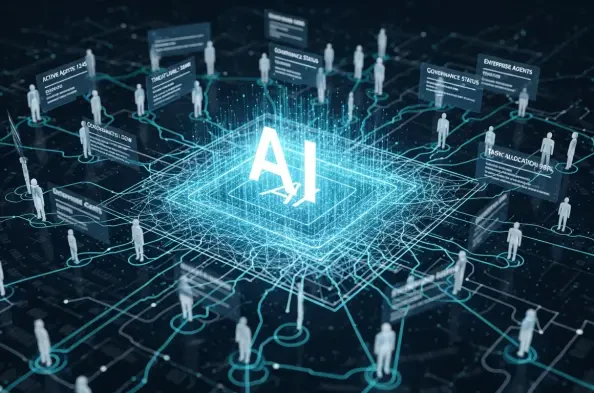
The moment an artificial intelligence system moves from suggesting a line of code to autonomously modifying a live database marks the birth of a new and precarious enterprise reality. For the past several years, organizations treated AI primarily as a sophisticated suggestion box—a digital consultant capable of drafting emails or summarizing meeting notes. However, the current landscape has evolved toward the era of the agentic execution surface. These agents no longer wait for a human to copy and paste their output; they possess the keys to the kingdom, authorized to open pull requests, trigger cloud deployments, and interact directly with production environments. This transition renders the initial excitement over simple productivity metrics secondary to a much more pressing structural concern: how does a business maintain control over a software entity that acts on its own? As these agents move from reading documentation to editing live codebases, traditional methods of oversight are proving insufficient, necessitating a centralized architectural layer known as the AI control plane.
This shift represents a fundamental change in the relationship between human intention and machine action. When an AI writes a block of code, it is a productivity tool, but when it executes that code within a continuous integration pipeline, it becomes a participant in the corporate workforce. The emergence of the control plane is a direct response to this newfound autonomy. It serves as a mandatory intermediary that interprets, validates, and logs every step an agent takes before it reaches the core systems of the business. Without this layer, the enterprise faces a “black box” execution problem where the logic behind a system modification remains opaque, and the authority to revert such changes is poorly defined. The control plane is not merely a security wrapper; it is the fundamental operating system for the next generation of autonomous enterprise software.
Beyond the Suggestion Box: When AI Claims the Keys to the Kingdom
The technological frontier has moved decisively beyond the “copilot” phase, where AI acted as a secondary navigator for human operators. In earlier iterations, the human remained the final arbiter of action, responsible for reviewing and committing every line of code or configuration change. Today, however, the enterprise is seeing the rise of agents that function as primary operators. These entities are capable of navigating complex file structures, understanding cross-functional dependencies, and making real-time decisions about system architecture. This transition turns the AI into an execution surface, a platform where code is not just written but actively deployed and managed. As these tools integrate more deeply with the internal guts of a company, the traditional boundaries of software development and system administration begin to blur, creating a landscape where an agent might identify a security vulnerability and patch it before a human operator is even aware of the threat.
This level of autonomy brings a unique set of risks that legacy governance frameworks are not equipped to handle. Traditional role-based access control (RBAC) was designed for human users who follow predictable patterns and operate within defined business hours. AI agents, by contrast, operate at machine speed and can perform thousands of operations in the time it takes a human to read a single log entry. If an agent misinterprets a prompt or encounters an edge case in a legacy codebase, the resulting cascade of errors can be instantaneous and widespread. The control plane acts as a necessary throttle on this speed, ensuring that while the AI can think and act quickly, it does so within a defined sandbox that protects the integrity of the broader ecosystem. It moves the focus from “what can the AI generate” to “what is the AI permitted to do,” establishing a regime of digital accountability.
The complexity of modern distributed systems further complicates this oversight. A single agentic action might touch multiple cloud providers, local databases, and third-party APIs simultaneously. Monitoring this behavior requires a sophisticated telemetry layer that can reconstruct the logic of an AI’s decision-making process in real-time. The control plane provides this visibility, offering a centralized dashboard where every autonomous action is mapped against business policies and security requirements. By treating the AI as an execution surface rather than a simple chatbot, organizations can begin to apply the same rigorous standards of testing and validation to AI agents that they currently apply to mission-critical infrastructure. This shift is essential for moving AI out of the experimental lab and into the heart of the enterprise production environment.
From Enthusiasm to Oversight: The Lifecycle of Enterprise AI Adoption
Most organizations follow a predictable and often turbulent path when integrating generative AI, beginning with a surge of grassroots adoption focused on raw speed. In this initial phase, individual teams and developers experiment with various models to see how much they can accelerate their daily workflows. The conversation is dominated by metrics of efficiency—how many hours were saved on unit testing, or how much faster a developer could debug a complex function. This “wild west” period is characterized by high enthusiasm and a lack of centralized coordination, as departments race to capture the competitive advantages offered by automated assistance. However, as these tools move from isolated tasks to integrated workflows involving sensitive internal systems, the tone of the conversation undergoes a significant shift.
The transition toward the “governance phase” usually occurs when the legal and security departments realize the implications of ungoverned AI. Once an AI tool is granted access to ticketing platforms, proprietary knowledge bases, and CI/CD pipelines, it is no longer an external utility; it is an internal vulnerability. Security leaders quickly realize that without a shared governance layer, they lack visibility into what the AI can see and where sensitive data is being transmitted. Concerns over “prompt leakage,” where internal trade secrets are inadvertently fed into public models, become a top priority for the C-suite. This realization marks the end of the honeymoon period and the beginning of a more disciplined approach to AI management, where the focus moves from individual tool performance to enterprise-wide risk mitigation and architectural stability.
As organizations mature, they seek to eliminate “shadow AI”—the unauthorized use of models by individual teams that bypasses corporate security protocols. The goal becomes the creation of a unified environment where every AI interaction is routed through a monitored gateway. This allows the enterprise to standardize its security posture, ensuring that every department follows the same rules for data privacy and model usage. This evolution from fragmented enthusiasm to structured oversight is not a sign of slowing down; rather, it is a sign of scaling up. By establishing a robust control plane, the organization creates a foundation that can support thousands of agents operating in parallel without risking a catastrophic failure or a massive data breach. It turns AI from a series of disjointed experiments into a reliable and governed corporate asset.
The Five Pillars: A Robust AI Governance Architecture
To transition from local experimentation to enterprise-grade execution, organizations must establish a control plane built on five fundamental requirements. First, identity management must treat AI agents with the same rigor as human employees. This involves linking bot actions to verified service accounts and integrating them into existing multi-factor authentication and conditional access frameworks. By giving every agent a unique and trackable digital identity, the enterprise can ensure that no action is anonymous. This pillar is essential for maintaining the “chain of custody” for any change made to the codebase or the production environment, allowing administrators to see exactly which agent initiated a specific process and under whose authority it was operating.
Second, the principle of least privilege must be strictly enforced through the control plane. Agents should not have blanket permissions across the repository; instead, they must operate with tiered access levels that are restricted to the specific task at hand. For example, an agent tasked with documentation should have read-only access to the code, while an agent tasked with deployment should only have write access to specific, non-critical branches until a human provides final approval. Third, the organization must centralize model access. This prevents teams from using unvetted or outdated models and ensures that only those with proven performance and security benchmarks are utilized for sensitive workloads. Centralization also allows for better cost management, as the enterprise can optimize model routing based on the complexity and priority of the request.
The final two pillars focus on data integrity and transparency. Context management governs how internal data is retrieved and fed into prompts to prevent accidental leakage and ensure the AI has the most accurate information. This involves sophisticated filtering and masking of sensitive data before it ever reaches the large language model. Finally, comprehensive auditability is required to provide a transparent, reconstructable trail of every action an agent takes. In a regulated environment, being able to explain “why” an AI made a certain decision is just as important as the decision itself. This audit trail is indispensable for compliance, incident response, and long-term accountability, providing the “black box” recorder for the AI’s autonomous behavior and ensuring that the organization can defend its automated processes to auditors and stakeholders.
Market Convergence: The New Standards of Technical Safety
The shift toward architectural governance is being aggressively operationalized by the world’s leading technology providers, signaling a broad consensus on the future of AI safety. Microsoft has positioned its Agent 365 framework as a dedicated control plane, focusing on unified telemetry and auditing that mirrors its existing enterprise data protection models. By integrating AI governance into the existing Azure and Microsoft 365 ecosystems, they are offering a path for organizations to manage agents using the same tools they use to manage their human workforce. Meanwhile, platforms like GitHub and Google have integrated enterprise-level controls directly into their development environments, treating AI safety as a core product feature rather than an optional add-on. This ensures that governance is “baked in” from the moment a developer starts their first project.
This market movement is supported by the latest industry research, such as the DORA reports, which suggest that AI acts as an amplifier of existing organizational strengths and weaknesses. The data indicates that companies with strong existing DevOps practices see the greatest benefits from AI, while those with poor governance see an increase in technical debt and security vulnerabilities. Furthermore, international standards from NIST and risk frameworks from OWASP are now highlighting “excessive agency” as a primary threat. These organizations have identified that giving an AI too much power without sufficient oversight is a top-tier vulnerability that could lead to unauthorized system changes or data exfiltration. The consensus among the global security community is clear: ungoverned AI autonomy is no longer a theoretical risk, but a practical danger that must be mitigated through structural design.
As these standards become more refined, they are beginning to influence the very architecture of the models themselves. Providers are increasingly building “safety layers” and “guardrail APIs” that can be integrated directly into the control plane. This allows an enterprise to set hard limits on what a model can discuss or do, regardless of the prompt it receives. We are seeing a convergence where the model providers, the cloud infrastructure companies, and the security vendors are all working toward a shared definition of a “safe” agent. This collaborative effort is creating a standardized set of protocols for AI execution, making it easier for companies to switch between different models while maintaining a consistent and rigorous governance posture across their entire digital estate.
Shifting Strategy: From Tool Selection to Operational Discipline
For leadership teams, the path forward requires a fundamental change in the quality of the strategic conversation regarding artificial intelligence. Instead of asking which specific assistant or copilot the company should purchase—a tactical decision with a short shelf life—executives must ask what control plane will govern AI regardless of where it runs. This strategic pivot moves AI out of “demo mode,” where the focus is on impressive one-off capabilities, and into “operating model territory,” where stability and security are the primary metrics of success. Implementing this framework involves establishing mandatory human-in-the-loop checkpoints and ensuring that AI governance is a cross-functional effort involving security, engineering, and risk management. This ensures that the AI remains a manageable asset rather than an unpredictable and potentially expensive liability.
The transition to an agent-first enterprise also requires a cultural shift in how teams perceive their roles. When AI agents take over repetitive execution tasks, human employees must shift their focus to higher-level design, review, and policy setting. This means that the “operators” of the future will be the people who design the guardrails and define the boundaries within which the agents work. Success in this new environment was measured by the ability to orchestrate a complex fleet of autonomous agents while maintaining a zero-trust security posture. Companies that prioritize this operational discipline over mere tool adoption are the ones that will find a sustainable competitive advantage, as they can scale their operations more rapidly and with fewer risks than their less disciplined peers.
Ultimately, the focus on the control plane reflects a maturity in the understanding of what AI actually is: a powerful but volatile engine that requires a robust steering mechanism. As businesses look toward the next several years of digital transformation, the winners were those who realized that the “magic” of AI lies not in the model itself, but in the system of control that surrounds it. By building a centralized, auditable, and permission-based layer, the enterprise ensured that it could harness the full potential of autonomous agents while keeping the keys to the kingdom firmly in human hands. This approach turned a potential security nightmare into a scalable engine for innovation, proving that in the age of automation, the most valuable technology was the one that provided the most effective oversight.
The implementation of these governance frameworks signaled the end of the experimental era and the beginning of a structured, execution-oriented phase of corporate history. Organizations successfully integrated AI into their core logic by treating agents as first-class citizens of the corporate hierarchy, subject to the same laws of identity and access as any other entity. Leaders abandoned the search for a single “magic bullet” application and instead invested in a resilient architecture that accommodated various models and vendors. This strategic foresight allowed the enterprise to maintain continuous compliance even as the underlying technology evolved at a rapid pace. By the time autonomous agents became the standard for software delivery and system management, the most successful firms already possessed the operational muscle to supervise them. This evolution solidified the role of the AI control plane as the essential mediator between raw computational power and organized business strategy, ensuring that the transition to an agentic future was as secure as it was transformative.