Vernon Yai is a sentinel in the world of data governance, a man who understands that a company’s secrets are never more fragile than when they are being discarded. With years of experience navigating the treacherous waters of privacy protection and risk management, he has become a leading voice for technology leaders who are tired of leaving their compliance to chance. In this discussion, we explore the often-overlooked dangers of hardware decommissioning and why the industry is undergoing a massive shift toward internalizing the data destruction lifecycle to ensure an unbreakable, verifiable chain of custody.
Our conversation dives into the heightened risks associated with SSD and backup media disposal, the inherent flaws in third-party logistics, and the evolving demands of regulatory frameworks like NIST 800-88. Vernon explains how transitioning to a closed-loop, in-house system provides the real-time logging and immediate decommissioning necessary to satisfy modern auditors and safeguard corporate reputations.
Many technology leaders find that data risk actually peaks when hardware like SSDs and backup media reach their end-of-life. What specific vulnerabilities emerge during the transition from active use to disposal, and how does the intensity of this risk compare to active data protection?
While an asset is in a server rack, it is shielded by layers of encryption and physical security, but the moment it is pulled for decommissioning, it enters a “gray zone” of extreme vulnerability. The risk intensifies because the data remains on the platter or flash chip, yet the active monitoring often stops, leaving these drives sitting in unsecured boxes or on loading docks where they are prone to theft. Unlike active data protection which is digital and automated, the disposal phase is physical and often chaotic, making it the weakest link in the entire lifecycle. It is a gut-wrenching realization for many CIOs that a single misplaced SSD could undo years of investment in perimeter defense and firewalls.
Third-party disposal involves multiple handoff points between internal teams, logistics providers, and downstream recyclers. At which stages do you see the most frequent documentation gaps, and what are the specific operational hurdles when trying to verify a secure chain of custody through external partners?
The most dangerous gaps occur during the initial handoff between the internal IT team and the logistics provider, where a simple signature on a manifest often masks a complete lack of real-time oversight. Once those assets leave your facility in a truck, you are essentially flying blind, relying entirely on a third party’s promise that the items arrived at the processing center intact. Verifying a secure chain of custody becomes an operational nightmare because you are forced to piece together a story from disparate logs and delayed reports provided weeks after the fact. It creates a sense of profound unease, knowing that your regulatory compliance rests in the hands of a driver or a warehouse worker who may not prioritize your data’s sanctity.
Regulatory frameworks like NIST 800-88 and HIPAA now demand defensible, repeatable processes rather than just a simple certificate of destruction. How should organizations restructure their internal workflows to meet these audit requirements, and what metrics best prove a process is truly “audit-ready”?
Organizations must move away from the “fire and forget” mentality of outsourcing and instead build workflows that prioritize immediate, verifiable action at the exact point of decommissioning. To satisfy frameworks like NIST 800-88, HIPAA, or DoD guidelines, you need to document the specific method of sanitization and provide a clear, unbroken timeline from the moment the device is retired. The best metrics for being “audit-ready” include the time elapsed between decommissioning and destruction, as well as the presence of real-time logging for every individual serial number. This shift ensures that if an auditor walks through your door, you are not scrambling for a paper trail but are instead presenting a seamless, automated record of total control.
Deploying high-security destruction equipment on-site allows for immediate decommissioning within a controlled environment. What technical specifications are necessary for this setup, and what step-by-step training do internal teams need to ensure real-time logging and standardized destruction workflows remain consistent?
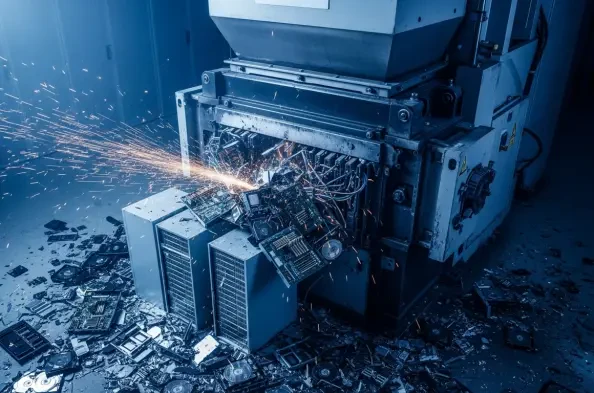
On-site setups require high-security equipment capable of rendering media completely unrecoverable, often involving industrial-grade shredders or disintegrators that meet rigorous government standards for particle size. Beyond the hardware, the internal team needs hands-on training that emphasizes the marriage of physical destruction with digital record-keeping through specialized software. We teach them to scan assets immediately, feed them into the machinery, and verify that the system generates a log entry that matches the internal inventory database. This standardized workflow eliminates the “human factor” of forgetfulness, ensuring that every drive is accounted for in a process that feels as routine and disciplined as a daily server backup.
Treating data destruction as a strategic component of enterprise risk management can build significant trust with stakeholders and regulators. How does a closed-loop destruction process influence broader cybersecurity posture, and what tangible advantages does this offer during a high-stakes regulatory audit?
A closed-loop destruction process sends a powerful signal to stakeholders that the organization values data integrity throughout its entire existence, not just while it is profitable or active. It strengthens the broader cybersecurity posture by closing the “back door” where retired assets often become the source of high-profile breaches that bypass traditional digital defenses. During a high-stakes audit, having the ability to demonstrate that no data-bearing asset ever left your physical control provides an incredible level of confidence and transparency. It transforms a stressful interrogation into a showcase of operational excellence, proving to regulators that you have total command over your information’s final, most vulnerable moments.
What is your forecast for the future of in-house data lifecycle management?
I predict that within the next few years, the traditional model of shipping live drives to off-site recyclers will be viewed as an unacceptable security liability for any organization handling sensitive information. As data volumes explode and regulations like HIPAA become even more granular, the “do-it-yourself” approach to destruction will become the industry standard for enterprise risk management. We will see a surge in the adoption of automated, high-security on-site solutions that integrate directly with asset management software to provide a “cradle-to-grave” digital footprint. Ultimately, the peace of mind that comes from knowing your data was destroyed within your own four walls is a luxury that will soon become a mandatory requirement for global business.