The pursuit of absolute cryptographic security has moved beyond the theoretical realm of perfect algorithms into a rigorous examination of the physical hardware that underpins modern communication. As digital threats evolve, the traditional reliance on trusted manufacturers is being replaced by a more robust zero-trust paradigm known as Device-Independent Quantum Key Distribution. This methodology operates on the principle that one does not need to trust the inner workings of a photon source or a detector to guarantee the privacy of a shared key. Instead of assuming these devices are free from backdoors or flaws, the protocol treats them as untrusted black boxes whose security is validated through the immutable laws of physics. Recent advancements have specifically targeted the high detection efficiency that once made these systems impractical for widespread use. New research led by Sujan Vijayaraj and Mauro Paternostro has introduced a groundbreaking multi-source routing protocol that effectively circumvents these historical bottlenecks, offering a practical path toward a more resilient and secure quantum future.
Transforming Quantum Network Architecture
Distributed Sources and Routed Connections
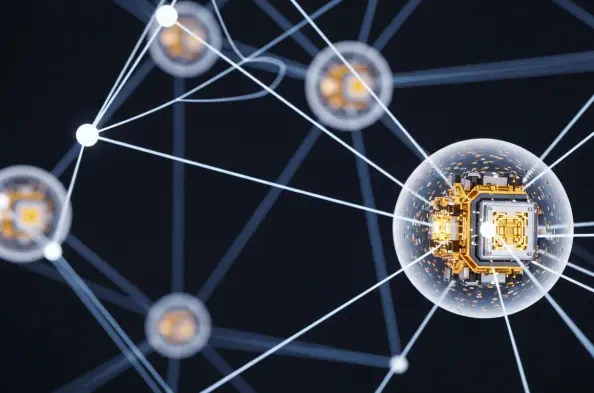
Shifting from a single, centralized quantum source to a decentralized multi-source architecture marks a fundamental change in how we conceive of secure long-distance links. Traditionally, a single source would attempt to distribute entangled particles across a vast distance, but signal attenuation and environmental noise frequently led to catastrophic loss. By segmenting these connections into smaller, manageable units, researchers have successfully mitigated the rapid degradation that occurs in point-to-point systems. This modularity allows for the creation of routed connections where signal integrity is maintained through localized verification at each node. Instead of demanding a single, flawless transmission across hundreds of kilometers, the network facilitates a series of shorter, highly efficient links that collectively form a secure corridor. This strategy significantly improves the robustness of the network, as it prevents local signal failures from compromising the entire communication chain, thus establishing a foundation for more reliable quantum infrastructure.
Central to this innovative framework is the sophisticated application of entanglement swapping, a process that enables the transfer of quantum properties between particles that have never directly met. In a multi-source environment, intermediate nodes perform specialized measurements that effectively stitch together independent segments of the network into a cohesive whole. This allows for the establishment of long-range correlations without the need for a single photon to travel the entire distance of the link. By utilizing these intermediate nodes as active routing points, the system can bypass the physical limitations imposed by fiber-optic loss and detector noise. The beauty of this design lies in its inherent resilience; because the protocol is device-independent, the security of the final key does not hinge on the perfection of any individual component. Even if specific hardware units exhibit minor operational flaws or manufacturing variances, the collective architecture maintains its cryptographic integrity. This approach provides a scalable solution for interconnecting diverse quantum devices into a functional and secure wide-area network.
Lowering Technological Barriers
Perhaps the most transformative outcome of the new multi-source protocol is the radical reduction in the efficiency requirements for physical hardware components. For several years, the scientific consensus held that achieving device-independent security required detectors and photon sources to operate at an efficiency threshold of at least 15 percent. This high bar acted as a major deterrent for commercial adoption, as creating hardware that consistently met these specifications was both difficult and expensive. However, the latest research demonstrates that by employing a routed multi-source approach, the required efficiency can be slashed to just 4.7 percent. This reduction effectively opens the door for a much wider range of existing technologies to participate in quantum networking. It changes the conversation from a search for perfect materials to an optimization of architectural strategies. By lowering the entry barrier, the protocol makes it feasible to deploy quantum keys using hardware that is already available or significantly easier to manufacture, accelerating the transition to secure communications.
The relaxation of hardware demands has profound implications for the speed and cost of building out a national quantum backbone. High-efficiency superconducting nanowire single-photon detectors, while capable, are often cumbersome and require cryogenic cooling, which limits their deployment in field environments. By lowering the efficiency requirement to under 5 percent, engineers can begin to explore a more diverse array of detection technologies, including those that operate at room temperature or require less specialized maintenance. This shift significantly reduces the capital expenditure needed for each network node and lowers the operational complexity of the system. Furthermore, it allows for a more forgiving manufacturing process for photon sources, as the network can now tolerate a higher degree of signal loss without failing the security checks. Consequently, the focus can shift toward improving the repetition rates and the scalability of these devices. This pragmatism is essential for moving quantum technology out of specialized laboratories and into the messy, unpredictable world of telecommunications infrastructure.
Strengthening Security and Global Scalability
Validating Security via Statistical Proofs
Ensuring the absolute privacy of a communication channel in an era of sophisticated cyber-warfare requires a level of verification that transcends standard digital signatures. The multi-source routing protocol achieves this through the rigorous application of the Clauser-Horne-Shimony-Holt framework. This mathematical tool allows users to verify the presence of non-local correlations—a hallmark of true quantum entanglement—without ever needing to inspect the internal state of the hardware. By performing randomized measurements at the end nodes of the network, the system generates a statistical score. If this score exceeds a specific threshold, it provides an irrefutable proof that the particles have not been tampered with and that no eavesdropper could have intercepted the key. This statistical bound is particularly powerful because it remains valid even when detection efficiency is relatively low. It provides a safety net that guarantees security based on the fundamental nature of reality, making the protocol resistant to even the most advanced interception techniques.
For environments where full device independence might be overly taxing, the researchers have also introduced the concept of dimension witnesses as a viable alternative. This semi-device-independent approach offers a strategic trade-off, allowing for higher secret key rates and easier implementation while still maintaining a very high level of security. By making a minimal assumption about the dimensionality of the quantum system, operators can significantly boost the performance of the network. This flexibility is crucial for the early stages of quantum deployment, where different users may have varying security requirements and hardware capabilities. Dimension witnesses act as a bridging technology, providing a pathway for organizations to upgrade their security protocols gradually. It allows network designers to tailor their security posture based on the specific risks they face, ensuring that high-value data receives maximum protection while less sensitive traffic can be handled with higher efficiency. This tiered approach to security is a hallmark of a mature communication system designed for real-world application.
Paving the Way for a Quantum Internet
The transition toward a distributed, multi-source model fundamentally changes the geometry of quantum networks from simple linear paths to complex, interconnected meshes. In a standard point-to-point link, a single break in the fiber or a malfunctioning detector can halt all communications instantly. However, the mesh-like structure supported by this new routing protocol introduces a critical layer of redundancy that is essential for a dependable global infrastructure. If a specific node or local link becomes unavailable due to technical failure or environmental interference, the protocol can dynamically reroute signals through alternative paths in the network. This level of resilience is a prerequisite for building a Quantum Internet that can support thousands of users simultaneously across different geographic regions. By moving away from the all-or-nothing nature of earlier designs, the multi-source architecture ensures that the network remains functional even in the face of localized disruptions. This reliability is what will ultimately drive the adoption of quantum technologies in critical sectors like finance and defense.
While the breakthrough in efficiency and routing marks a significant milestone, the path forward involves refining these systems to increase the speed of key generation. Current experimental setups provide the proof of concept, but high-speed data applications will require a faster throughput of secure keys to meet modern demand. Future efforts are likely to focus on the development of more advanced error correction techniques that can handle the specific types of noise encountered in long-range fiber optics. Additionally, optimizing the routing strategies through artificial intelligence could allow the network to self-heal and manage traffic loads more effectively. These continuous refinements in both hardware and software are bringing the world much closer to a future where privacy is no longer a matter of trust but a physical certainty. As these technologies mature, they will form the invisible backbone of a secure digital society, ensuring that the fundamental right to private communication is preserved against all odds through the unbreakable laws of quantum mechanics.
The recent advancements in multi-source routing for device-independent keys shifted the focus from hardware perfection to architectural intelligence. This transition provided a clear roadmap for organizations to implement high-security protocols using existing infrastructure without the need for prohibitive capital investments. As these protocols moved into the pilot phase, the strategic integration of modular entanglement swapping proved to be a decisive factor in overcoming long-distance signal loss. Moving forward, stakeholders in the telecommunications sector prioritized the adoption of decentralized node architectures to build the necessary redundancy for a future-proof network. Investing in standardized routing protocols and semi-device-independent alternatives became essential for scaling these systems to a global level. By embracing these physical security bounds, the industry effectively neutralized the threat of computational attacks on sensitive data. The focus shifted to refining error-correction algorithms and improving the throughput of key generation to ensure that quantum-secured channels could handle the massive data volumes of modern enterprises.