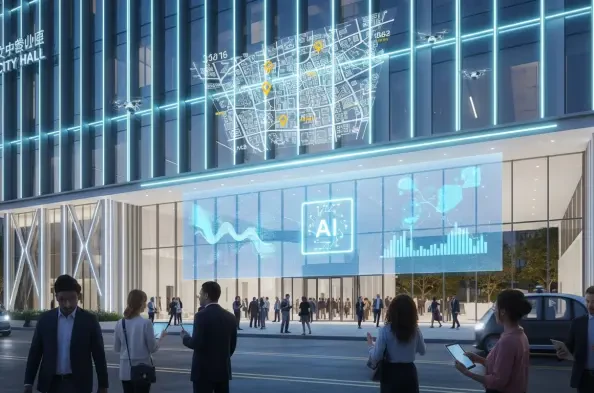
The crushing weight of administrative backlog has long been the silent killer of urban development, yet a profound shift in Bellevue, Washington, is proving that silicon and code can dismantle decades of bureaucratic friction. As cities grapple with explosive growth and housing shortages, the traditional permitting office has transitioned from a paper-laden bottleneck into a high-tech nerve center. This review examines how the integration of Large Language Models (LLMs) and automated workflows is not just speeding up paperwork but fundamentally rewriting the social contract between local government and the public. By moving beyond simple digitization toward true cognitive automation, these systems provide a template for a more responsive, data-centric civic infrastructure that prioritizes results over process.
Evolution of AI in Civic Administration
The journey from manual data entry to AI-assisted governance marks a pivotal transition in the “Civic Tech” landscape. Historically, municipal permitting was a labyrinth of complex code interpretation and endless “back-and-forth” cycles that could stall vital infrastructure for months. The emergence of specialized AI tools has shifted the paradigm, allowing cities to leverage the reasoning capabilities of modern language models to navigate dense regulatory frameworks. Unlike legacy software that merely stored documents, these new systems understand the context of building codes, creating a bridge between abstract laws and tangible construction projects.
This technological maturation is largely driven by the need for scalability in the face of rapid urbanization. As municipal staff populations remain stagnant, the volume of development requests continues to climb, necessitating a force multiplier. AI serves this role by acting as a persistent digital assistant that never tires and maintains a consistent interpretation of rules. This evolution represents a broader move toward “Smart Government,” where data is not just archived but actively utilized to provide intelligent, real-time assistance to both public servants and citizens alike.
Core Technical Components and System Architecture
Knowledge Management and Internal Support Systems
At the heart of this transformation lies an internal intelligence hub designed to empower municipal employees. By utilizing natural language processing, the system functions as a specialized jurisdictional expert capable of parsing thousands of pages of zoning laws and building ordinances. When a staff member needs to verify a specific setback requirement or a niche environmental regulation, they no longer have to manually cross-reference multiple PDF documents. Instead, they interact with a retrieval-augmented generation (RAG) system that provides cited, accurate data in seconds.
This internal tool is unique because it eliminates the “tribal knowledge” problem where specific code interpretations exist only in the heads of senior planners. By democratizing access to complex information, the city ensures that a junior clerk can provide the same level of accuracy as a twenty-year veteran. This consistency is vital for legal defensibility and public trust, as it ensures that every applicant is held to the exact same standard, regardless of which desk their file happens to land on.
Real-Time Applicant Guidance and Predictive Validation
The public-facing side of this technology acts as a digital concierge, offering proactive feedback during the submission process to ensure “clean” submittals. Using predictive validation, the AI analyzes application materials in real-time, identifying missing signatures, mismatched site plans, or non-compliant architectural details before the “submit” button is even pressed. This is a radical departure from the traditional model where an applicant waits weeks only to receive a rejection notice for a minor clerical error.
What sets this implementation apart from standard web forms is its ability to interpret intent. If a developer submits a proposal for a multi-family dwelling in a single-family zone, the AI can immediately flag the discrepancy and suggest the necessary variance forms. This preemptive correction loop significantly reduces the administrative load on city reviewers, as they only receive documents that have already passed a rigorous digital pre-check. It transforms the permitting office from a gatekeeper into a facilitator of compliant development.
Automated Application Triage and Workflow Routing
Complexity-based triage represents the third pillar of the system architecture, utilizing machine learning to categorize incoming requests based on risk and technical requirements. Simple permits, such as residential solar installations or basic heat pump replacements, are automatically flagged for expedited “fast-track” processing. Meanwhile, high-impact commercial developments are routed to specialized human experts who possess the nuance required for high-value problem solving.
This optimization ensures that human capital is deployed where it is most effective. By stripping away the routine administrative tasks that typically consume seventy percent of a reviewer’s day, the city can focus on the thirty percent of cases that truly require professional judgment and community sensitivity. This tiered approach prevents minor projects from clogging the system, ensuring that the velocity of city growth is not limited by the speed of a manual queue.
Trends in Procurement and Public-Private Partnerships
The successful deployment of these AI tools has required a total rethinking of how cities acquire technology. Traditional Request for Proposal (RFP) processes are often too rigid and slow for the fast-moving AI sector, frequently favoring large, established incumbents over agile startups. To counter this, forward-thinking municipalities are adopting “Innovative Design Partnerships.” These frameworks prioritize rapid prototyping and co-development, allowing city officials to work alongside developers to tailor tools to specific local needs rather than buying off-the-shelf software that fits poorly.
This shift has lowered the barrier to entry for cutting-edge technology providers, fostering a more competitive and innovative ecosystem. By focusing on milestones and iterative testing rather than decades of government-specific credentials, cities can access the latest breakthroughs in machine learning much faster. These partnerships also ensure that the technology is built with a deep understanding of municipal workflows, creating a sense of ownership among city staff that is often missing during top-down software rollouts.
Real-World Applications and Sector Impact
In practice, AI-driven permitting is proving to be a catalyst for housing production in high-demand metropolitan areas. By slashing approval timelines, cities can lower the carrying costs for developers, which theoretically translates to more affordable units reaching the market sooner. Beyond housing, these systems are being used in “Innovation Forums” where city leaders and nonprofits collaborate to ensure the technology supports local economic goals. These forums act as a feedback loop, ensuring the AI is tuned to favor sustainable building practices or equitable development in underserved neighborhoods.
The impact extends to environmental monitoring as well, as AI can quickly calculate the cumulative impact of multiple projects on local infrastructure or tree canopy coverage. This allows for a more holistic view of urban planning that was previously impossible to achieve through manual review. The technology essentially provides a “digital twin” of the city’s regulatory environment, allowing planners to simulate the impact of code changes before they are officially enacted.
Implementation Challenges and Mitigation Strategies
Despite the clear benefits, the transition is not without significant hurdles, primarily regarding “data hygiene.” AI is only as reliable as the records it is trained on, and many cities suffer from decades of poorly scanned documents and inconsistent legacy data. Cleaning this data is a monumental task that requires significant upfront investment. Furthermore, there is the ever-present risk of algorithmic bias, where an AI might inadvertently favor certain types of developments or neighborhoods based on historical data patterns.
To mitigate these risks, developers are implementing “human-in-the-loop” systems. These ensure that while the AI can suggest actions or draft responses, a human official must always provide the final sign-off. Traceability functions have also become a standard requirement, allowing users to audit the logic behind an AI’s suggestion. This transparency is crucial for maintaining public accountability and ensuring that the “black box” of AI does not replace the democratic oversight of local government.
Future Outlook and Scalability
Looking ahead, the potential for AI in municipal permitting points toward a fully integrated “Smart City” ecosystem. Future iterations will likely link permitting directly to real-time infrastructure planning and environmental sensors. For instance, a permit for a new commercial building could automatically trigger updates to the city’s traffic management AI or its water usage projections. Generative AI may also reach a point where it can draft complex, legally binding permit responses or even suggest optimizations to a developer’s blueprints to better meet city energy goals.
Scalability remains the final frontier. While larger, tech-heavy cities have led the way, the next phase will involve creating “lite” versions of these tools for smaller townships with limited IT budgets. This democratization of technology will ensure that efficient governance is not a luxury reserved for wealthy metropolitan hubs. As these systems become more modular and affordable, they will redefine the baseline expectation for civic service, making it as seamless as any private-sector digital experience.
Assessment of Current Technological Impact
The adoption of AI-driven permitting marked a decisive victory over the stagnation of legacy bureaucracy. By successfully reducing staff hours by nearly a third and cutting permit resubmissions in half, the technology proved that the “frictionless city” was an attainable goal rather than a futuristic fantasy. While the initial stages required heavy lifting in data cleanup and a total overhaul of procurement policies, the long-term gains in administrative efficiency and developer satisfaction justified the investment. The shift toward human-centric design and transparent, auditable logic ensured that the technology remained a tool for public good rather than a replacement for human judgment. Moving forward, the focus must remain on expanding these capabilities into broader urban planning sectors, ensuring that the digital infrastructure of our cities remains as resilient and dynamic as the physical buildings it helps create.