The transition from simple chatbots to autonomous agents capable of independent decision-making has fundamentally altered the technological requirements for modern global enterprises. This movement represents a significant departure from the era of “stochastic parrots,” where systems merely predicted the next word in a sequence based on statistical probability. Today, the focus has shifted toward goal-oriented AI that understands the implications of its actions within a specific commercial framework. However, the move toward autonomy has exposed a profound weakness in the current digital infrastructure: the high cost of misunderstanding. When generic models are applied to complex, proprietary business logic, they often fail to grasp the specific nuances that define a brand, a policy, or a workflow.
The retail sector provided one of the most visible warnings of this deficiency through the recent experience of Walmart and its shopping features. By attempting to use general-purpose Large Language Models (LLMs) to interpret product data without a rigid semantic framework, the company faced a surge in hallucinated information. This lack of grounding led to a drastic drop in conversion rates, which were reportedly three times lower than those achieved on their standard, human-curated digital platforms. This failure demonstrated that without a precise, shared understanding of the underlying data, AI agents cannot provide the reliability or safety required for high-stakes business environments.
Grounding AI in Reality: The Urgent Need for Semantic Context
The friction between raw data storage and the nuanced meaning required for business operations is often described as the “semantic gap.” In the current market, simply processing data is no longer sufficient; instead, the next era of enterprise AI focuses on processing meaning and intent. AI agents must be able to interpret instructions within the specific context of an organization’s history, rules, and goals. This requirement transforms business logic from a background element into a “North Star” that guides autonomous decision-making to ensure accuracy and safety.
Moving beyond simple data retrieval, grounded AI requires a framework where every piece of information is tethered to its real-world implication. If an agent is tasked with managing inventory, it must understand not just the number of items in a database, but the business rules regarding lead times, supplier reliability, and seasonal demand shifts. When an agent lacks this grounding, it operates in a vacuum, leading to the types of errors that erode customer trust and operational efficiency. Therefore, the focus has shifted from the volume of inputs to the quality of meaning derived from those inputs.
Internal Precision vs. External Isolation: The Role of Semantic Hubs
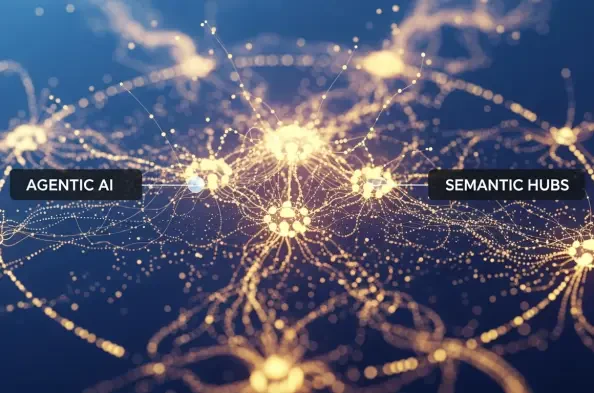
A semantic hub functions as a centralized “Single Source of Truth,” translating unstructured data into consistent business concepts that prevent the phenomenon known as semantic drift. By creating a unified architectural framework, these hubs bridge the gap between human expertise and machine logic, ensuring that an agent interprets a concept exactly as the organization intends. This precision is vital for internal operations where consistency is the primary metric of success for automated workflows. These hubs allow complex organizations to maintain a coherent identity across various departments, even as they deploy hundreds of different AI agents.
However, a significant bottleneck emerges when proprietary hubs create “walled gardens” that inhibit collaboration across organizational boundaries. While a company might achieve internal alignment, its AI agents often remain isolated from the broader ecosystem of suppliers, regulators, and customers. This interoperability crisis poses a direct threat to the realization of a truly global agentic economy. McKinsey projections suggest that agentic commerce could drive up to $5 trillion in economic value, but this potential remains locked if agents from different companies cannot speak the same semantic language.
Breaking the Language Barrier: Open Semantic Interchange (OSI)
Existing technical protocols like the Model Context Protocol (MCP) or Agent2Agent (A2A) provide the necessary infrastructure for communication, yet they function merely as “piping” without a shared mental model. The alliance between Salesforce and Snowflake to launch the Open Semantic Interchange (OSI) addressed this deficit by proposing a universal language for AI agents. This standard ensures that the intent behind a data definition is preserved even as it moves between different software environments and organizational jurisdictions. It provides the “Rosetta Stone” needed for an agent in one company to understand the pricing structures or service levels of an agent in another.
This strategic shift is beginning to commoditize data definitions, forcing vendors to compete on execution, speed, and security rather than on customer lock-in through proprietary data formats. By adopting an open standard, organizations can move away from siloed languages that previously restricted their flexibility and prevented them from switching service providers. Industry analysts view this unified semantic layer as the fundamental building block for a global economy where agents can negotiate and transact with one another without constant human intervention or manual translation of complex data schemas.
A Roadmap for Implementation: Transitioning to an Open Semantic Future
The technological landscape evolved rapidly as native import and export capabilities for semantic models became the standard across all major data platforms. For the modern Chief Information Officer, the immediate priority was the transition from siloed, proprietary data models to interoperable standards. This journey involved identifying the roles of early adopters like Databricks and Cloudera, while navigating the “wait-and-see” approach initially taken by some legacy technology giants. High-stakes industries, including healthcare and banking, discovered that they could layer domain-specific nuances onto the OSI framework, maintaining high levels of security while still benefiting from broader connectivity.
Enterprises that prioritized semantic grounding found themselves better positioned to capture the immense value of autonomous commerce. The transition proved that a shared language was the only way to move beyond the limitations of isolated systems. The global market eventually recognized that interoperability was not just a technical preference but a core requirement for survival in a world defined by agentic intelligence. Looking ahead, the focus must remain on the continuous refinement of these open standards to ensure they can accommodate the increasing complexity of human-agent collaboration and the rigorous demands of emerging regulatory frameworks. Organizations must now audit their existing semantic assets to ensure they are compatible with an open, interconnected future.