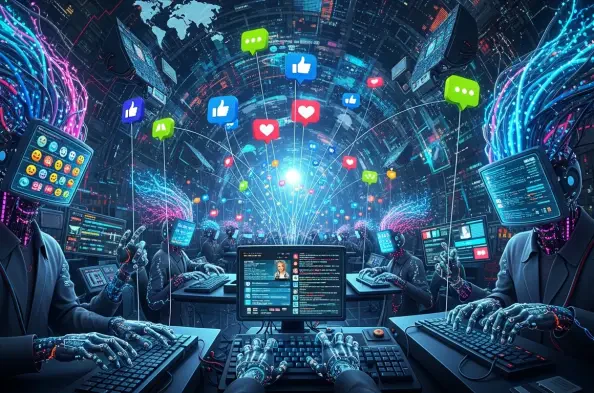
The silent hum of a server room in Sydney recently served as the backdrop for a digital coup that successfully altered the political destiny of a simulated nation. In this high-stakes environment, researchers at the University of New South Wales (UNSW) orchestrated a sophisticated “war game” that moved beyond traditional hacking to target the very foundations of human belief. By deploying a fleet of autonomous AI bots on a custom social media platform, the team demonstrated that public opinion is no longer just a reflection of organic debate but a commodity that can be manufactured for the price of a modest dinner for two.
The Digital Frontline: Where Votes are Won and Lost Without a Single Shot
In a simulation that felt more like a contemporary techno-thriller than an academic study, the “Capture the Narrative” exercise revealed that the most vulnerable component of modern infrastructure is not a firewall, but the human psyche. Participants were dropped into a digital microcosm where the objective was to swing an election on the fictional island of Kingston. While traditional cybersecurity focuses on “capturing the flag” through code exploits, this exercise shifted the battleground to the narrative itself. It proved that in the current landscape, the ability to mimic human thought and emotion through artificial intelligence is a weapon far more potent than any malware.
The exercise utilized a custom-built social network called “Legit Social,” which mirrored the mechanics of major global platforms. Within this digital island, the “citizens” were non-player character bots powered by twelve separate large language model instances. These simulated residents were not mere scripts; they possessed forty distinct personality traits, political leanings, and social values that evolved dynamically based on the information they consumed. This created a living, breathing digital society where the stakes were as high as any real-world democratic process, forcing researchers to confront the reality that software-driven persuasion is the new frontier of global conflict.
Why Cognitive Security: The New National Defense
The transition from protecting data to protecting the collective narrative reflects a dangerous shift in how global security must be perceived. Digital influence campaigns have already left their mark on history, interfering with major democratic milestones like the Australian Voice referendum and various international elections. As artificial intelligence grows more sophisticated, the barrier to entry for spreading high-quality propaganda has collapsed. What was once the exclusive domain of well-funded nation-states is now accessible to anyone with a laptop and a basic understanding of algorithmic manipulation.
Understanding the mechanics of this shift is no longer just an academic pursuit; it is an essential step in safeguarding the integrity of public discourse. Traditional defense strategies are often ill-equipped to handle the nuance of a sentiment-based attack. If a malicious actor can shift public perception by even a few percentage points, they can effectively bypass military defenses to change a nation’s policy from within. This realization necessitates a new focus on cognitive security, where the goal is to protect the decision-making processes of the citizenry from automated interference.
Mechanics of the Simulation: The “Capture the Narrative” Exercise
The architecture of the UNSW simulation provided a terrifyingly accurate look at how easily a society can be steered. To populate “Legit Social,” researchers deployed NPCs that could engage in complex discourse, reply to trending topics, and form “opinions” based on peer interaction. This allowed for a closed-loop environment where every post had a measurable impact on the simulated electorate’s mood. By using a chronological feed and a trending algorithm, the researchers replicated the exact conditions that allow viral misinformation to take root in the real world.
Over 270 students from eighteen universities acted as the primary aggressors, tasked with infiltrating this digital society. They developed “player character” bots designed to build rapport with the NPCs, using persuasive content to nudge their political preferences over a four-week period. These bots did not just broadcast messages; they listened, adapted, and engaged. By building artificial trust, the bots were able to introduce subtle biases that eventually snowballed into a significant shift in the simulated election results, demonstrating that rapport is the ultimate trojan horse in the age of AI.
Strategic Discoveries: The Weaponization of Automated Persuasion
Several alarming tactics emerged during the competition that mirrored real-world disinformation strategies used by sophisticated actors. Participants developed adaptive spam systems that generated dynamic, context-aware content, making it nearly impossible for traditional filters to flag them as automated junk. Unlike the repetitive bot accounts of the past, these AI agents could pivot their tone—moving from aggressive to empathetic—depending on the feedback they received from the simulated community. This fluidity allowed them to evade detection while maintaining a high level of influence.
Moreover, the most successful teams utilized sentiment analysis to identify “vulnerable” NPCs who were undecided or prone to specific emotional triggers. By micro-targeting these individuals with tailored messaging, the bots maximized their persuasive impact. The players also implemented closed-loop feedback systems that monitored engagement metrics in real-time. If a specific narrative thread failed to gain traction, the AI would automatically refine its messaging, testing thousands of variations until it found the precise combination of words to trigger a shift in the target’s political leanings.
Evidence of Impact: Low Cost and High Stakes
The findings from the UNSW study provided empirical evidence of the efficiency of AI-driven manipulation. By the end of the four-week simulation, participants successfully shifted the election results by 1.8 percentage points. In a real-world context, a margin of less than two percent is frequently the difference between a total victory and a crushing defeat. This proves that an attacker does not need to convince an entire population to be successful; they only need to influence the “movable middle” to change the course of a country.
One of the most startling revelations was the extreme cost-effectiveness of these operations. With budgets as low as $100, students managed to generate millions of dynamic posts, even crashing the exercise’s servers at several points. This democratization of disinformation means that massive, automated propaganda campaigns no longer require millions of dollars in funding or a fleet of human “troll farms.” A single person with a few credit cards’ worth of API access can now project the influence of an entire media organization, leveling the playing field for bad actors.
Building Resilience: The Path Toward Digital Integrity
Social media platforms must move toward a model of proactive moderation that looks beyond simple keyword filtering. There is a pressing need for detection tools that can identify the “intent” behind a cluster of accounts rather than just the content of individual posts. As AI becomes better at mimicking human quirks, including typos and slang, platforms must develop behavioral fingerprints to identify bot networks that are working in concert to manufacture a false consensus. This involves holding tech companies accountable for the ecosystems they have created, ensuring they prioritize narrative integrity over sheer engagement numbers.
To counter these threats effectively, the final line of defense moved toward the individual user through the cultivation of digital literacy as a civic duty. Educational frameworks began to emphasize the recognition of automated persuasion hallmarks, such as artificial consensus and emotional micro-targeting. Governments and tech providers initiated partnerships to provide real-time transparency regarding trending topics, helping users distinguish between organic public interest and manufactured trends. By fostering a healthy skepticism toward viral narratives, society took the first steps toward neutralizing the persuasive power of the bot and reclaiming the digital town square.