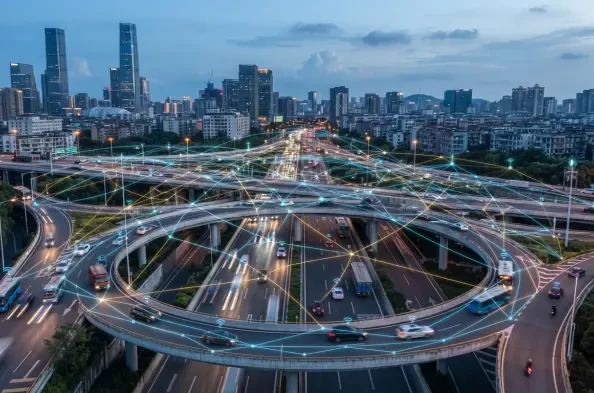
Mimicking the cooperative hunting strategies of Harris hawks enables a network to identify transmission trajectories with the lowest possible latency and highest stability. This biological inspiration forms the backbone of the CRAHO framework, a sophisticated response to the inherent volatility of Vehicular Ad Hoc Networks (VANETs). As these networks become the foundation for modern Intelligent Transportation Systems, the need for seamless communication between high-speed vehicles and urban infrastructure has never been more pressing. However, the technical landscape is fraught with difficulties, as the rapid movement of vehicles creates a topology in constant flux. Identifying efficient transmission paths under these conditions is not merely a logistical hurdle but a complex mathematical challenge classified as an NP-hard optimization problem. Traditional routing protocols, which served the industry well in simpler environments, often fail to adapt to the split-second changes required for road safety applications. The introduction of hybrid metaheuristic models like CRAHO represents a shift toward more resilient, adaptive systems that can anticipate network shifts rather than simply reacting to them. By synthesizing the behavioral patterns of different species, researchers have discovered a way to balance the broad exploration of network possibilities with the precise exploitation of established data paths, ensuring that the promise of fully connected and autonomous traffic remains a viable reality in today’s demanding urban settings.
Challenges of High Mobility in Urban Environments
The primary obstacle in vehicular networking remains the hostile operational environment created by varying vehicle speeds and complex urban trajectories. This constant movement causes the network topology to fluctuate at an extreme rate, resulting in frequent signal interference and disconnected communication links that can paralyze data flow. When the topology shifts unpredictably, data packets often fail to reach their destination, which is unacceptable for safety-critical applications such as emergency braking alerts or intersection collision avoidance. The physical reality of the city, with its skyscrapers and moving obstacles, adds another layer of complexity by introducing signal fading and multipath effects. For a network to remain functional, it must be able to predict where a vehicle will be in the next few milliseconds and ensure that the wireless handshake between nodes remains intact despite the Doppler shifts and attenuation common in high-speed travel. Consequently, maintaining a stable link becomes a race against time and physics, where the overhead of constant reconnection can easily consume the available bandwidth meant for actual data transmission.
To manage this overwhelming complexity, engineers and researchers frequently utilize clustering techniques, where vehicles are organized into smaller, manageable groups governed by a designated cluster head. While this hierarchical approach significantly simplifies the network structure by reducing the number of nodes participating in direct routing decisions, selecting a stable leader remains a significant hurdle. If a cluster head moves out of range too quickly or changes its trajectory abruptly, the entire group must undergo a reorganization process, creating substantial computational overhead and unwanted latency. Standard optimization algorithms, including genetic algorithms or basic particle swarm optimization, often struggle in these scenarios because they get stuck in local optima. This means they settle for solutions that are temporarily adequate but fail to maintain long-term stability as the network evolves. The challenge lies in developing a system that can look beyond immediate gains to identify cluster heads and routes that will remain viable even as traffic density increases and vehicle speeds vary across the urban grid.
Evolution of Clustering through Swarm Intelligence
The CRAHO protocol introduces a sequential two-stage process designed to ensure both rigorous network organization and efficient data delivery through a hybrid metaheuristic approach. The first phase employs the Crow Search Algorithm to handle the global exploration of the network landscape for the specific purpose of cluster head election. Modeled after the intelligent social behavior of crows, which are known for their ability to cache food and monitor the behavior of peers to prevent theft, this stage focuses on identifying the best candidates for leadership by scanning the entire topological environment. Instead of looking at nodes in isolation, the algorithm evaluates potential cluster heads through a multiobjective fitness function that prioritizes stability. By simulating the awareness probability of a crow, the system can decide whether to follow a known successful configuration or jump to an entirely new area of the network to find a better leader. This global search capability is essential for avoiding the premature convergence that plagues many single-stage systems, allowing the network to remain flexible even during peak traffic hours when the number of potential connections grows exponentially.
Once the global search provides a set of viable candidates, the system refines its choice by considering a weighted set of variables including relative velocity, distance between vehicles, and node degree. Relative vehicular velocity is given the highest priority because vehicles moving at similar speeds are naturally more likely to stay within communication range of one another for longer durations, thereby reducing the frequency of costly reclustering events. Following the election of these stable leaders, the protocol transitions into its second phase, which utilizes Harris Hawks Optimization to manage the intricate process of inter-cluster routing. This stage mimics the cooperative “surprise pounce” hunting strategies of hawks to narrow down the most effective multi-hop paths for data transmission across the network backbone. By focusing on exploitation, the algorithm identifies the most reliable trajectories between cluster heads and roadside units, ensuring that information travels the shortest and most stable path possible. This dual-layered strategy effectively splits the computational burden, using one specialized algorithm for organization and another for execution, which results in a much more responsive and durable communication framework.
Mathematical Precision: The Stochastic Trigger Mechanism
A defining technical innovation within this hybrid framework is the implementation of a nonlinear stochastic trigger derived from the awareness probability found in crow search dynamics. In the fast-moving world of vehicular ad hoc networks, even the most efficient hunting algorithms like Harris Hawks Optimization can occasionally stagnate if they focus too heavily on a single “best” path that is rapidly becoming obsolete. The stochastic trigger acts as a mathematical fail-safe; it monitors the fitness gradient of the current routing paths and detects when the rate of improvement begins to plateau. If the system senses that the algorithm is about to become trapped in a suboptimal configuration, it triggers a global exploratory jump. This mechanism essentially forces the network to look for new routing possibilities before the current ones fail, allowing for a proactive rather than reactive management of data flows. Such precision is critical in 2026, where the density of connected devices on the road requires algorithms that can handle massive data sets without experiencing the lag associated with traditional computational bottlenecks or fixed-path routing limitations.
The effectiveness of this mathematical approach was validated through extensive simulations that combined the logical processing power of MATLAB with the realistic mobility modeling of SUMO. These tests were conducted within a 2000-meter by 2000-meter Manhattan grid, providing a challenging environment characterized by sharp turns, varying street lengths, and high-density intersections. To ensure the results were applicable to real-world scenarios, the researchers utilized the Krauss car-following model, which accurately simulates the nuances of human and automated driving, such as gradual braking, acceleration curves, and the queuing behavior seen at traffic lights. Furthermore, the communication layer was modeled after the IEEE 802.11p standard for Wireless Access in Vehicular Environments, incorporating Nakagami-m fading to account for the signal degradation caused by buildings and other urban obstacles. By testing the protocol against a range of vehicle densities—from sparse nighttime traffic to congested midday rushes—the simulation provided a comprehensive look at how hybrid optimization scales under pressure, proving that mathematical sophistication can indeed translate into tangible network reliability.
Validating Performance through Rigorous Urban Simulations
The quantitative findings from these simulations revealed that the CRAHO framework significantly outperforms traditional protocols like AODV and EEWCA across all critical performance indicators. Most notably, the packet delivery ratio remained consistently high, averaging over 91% even in scenarios with high vehicle density and rapid mobility. This indicates that the hybrid algorithm is exceptionally successful at maintaining link integrity, ensuring that safety messages and traffic data are not lost in the “noise” of the urban environment. Additionally, the end-to-end delay was reduced to approximately 43 milliseconds, a figure that sits well within the threshold required for most autonomous driving safety standards. In the context of modern transportation, where a few milliseconds of delay can mean the difference between a successful collision avoidance maneuver and a serious accident, this reduction in latency represents a major leap forward. The ability to process and route information so quickly, despite the complexity of the underlying optimization problem, highlights the efficiency of the hawk-inspired hunting phases in identifying the most direct paths.
Beyond the immediate benefits of speed and reliability, the hybrid optimization approach also demonstrated a superior ability to manage network throughput and energy consumption. By distributing the transmission load across the most stable cluster heads and minimizing the number of hops required for data to reach its destination, the protocol achieved a throughput improvement of nearly 14% over baseline systems. This efficiency has a direct impact on the longevity of the network nodes; by reducing the amount of power wasted on redundant transmissions and frequent reclustering, the framework extended the functional lifetime of vehicle batteries by 18% to 24%. This is a crucial consideration for the integration of smaller, battery-powered sensors and communication units that form the peripheral edges of the Internet of Things on our roads. The data suggests that by optimizing the way vehicles “talk” to one another, we can create a more sustainable digital ecosystem that requires less maintenance and offers higher overall availability for all road users, regardless of their specific hardware constraints.
Future Directions: Toward Resilient Next-Generation Networks
The research into hybrid metaheuristic optimization successfully demonstrated that combining the exploratory power of crow-inspired algorithms with the exploitative precision of hawk-inspired hunting patterns created a more stable vehicular network. By implementing a two-stage pipeline, the CRAHO framework addressed the NP-hard challenges of clustering and routing that had previously limited the reliability of high-speed communication on the road. The inclusion of a stochastic trigger proved essential in preventing the system from settling into suboptimal states, ensuring that data paths remained viable even as urban traffic patterns shifted in real time. These findings established a clear baseline for the next generation of intelligent transportation systems, where the integration of bio-inspired logic and rigorous mathematical modeling can overcome the physical limitations of wireless links in motion. The resulting improvements in packet delivery, latency, and throughput provided the empirical evidence needed to move these concepts from simulated environments toward broader industrial application.
To build on these successes, future development should prioritize the integration of deep reinforcement learning to further refine the predictive capabilities of the network. While the current hybrid models performed admirably, the next step involves using artificial intelligence to anticipate link failures before they occur, allowing for an even more proactive management of the vehicular grid. Researchers also highlighted the necessity of adapting these protocols for the emerging 6G standards, which will offer the ultra-low latency and massive bandwidth required for full-scale autonomous fleets. Additionally, future iterations must incorporate more robust security protocols and trust management systems to protect the cluster-head backbone from potential cyber threats or malicious nodes. By focusing on these actionable areas—AI-driven prediction, 6G compatibility, and enhanced security—the industry can transition from stable simulated networks to a secure, real-world infrastructure that supports the safe and efficient movement of people and goods across the global urban landscape.