The moment a developer clones a production database into a staging environment without sufficient oversight, the organization’s attack surface expands exponentially and often without warning. In the current landscape of 2026, where data privacy regulations have become increasingly stringent and cyber threats more sophisticated, the traditional practice of using “sanitized-ish” data is no longer a viable security posture. Organizations are now forced to reconcile the need for high-fidelity testing environments with the absolute requirement to protect personally identifiable information (PII). When sensitive records like social security numbers, physical addresses, or financial details migrate from protected production silos into less secure staging tiers, the risk of a catastrophic leak becomes a matter of contingency rather than probability. This challenge has led to the development of sophisticated, automated lifecycles designed to manage test data with surgical precision. By removing the human element from the data movement process, companies can ensure that not a single byte of raw customer information ever touches a developer’s local machine or a shared testing server. The following analysis explores a robust pipeline that automates this transition, providing a blueprint for secure, compliant, and efficient software development lifecycles that satisfy both security auditors and engineering leads.
Establishing a programmatic approach to data masking starts with the understanding that manual intervention is the enemy of consistency. If a security team relies on a database administrator to manually export and scrub tables, the process will eventually suffer from human error or be skipped entirely during a high-pressure release cycle. Automation transforms this liability into a predictable, repeatable service. When the workflow is triggered, the system operates within a defined “clean room” environment, where data is transformed before it ever reaches its final destination. This architectural choice ensures that the staging environment—which often has broader access permissions for developers, quality assurance testers, and automated CI/CD pipelines—remains entirely free of actual sensitive information. By shifting the focus from “protecting the staging database” to “ensuring only safe data enters the staging database,” organizations can maintain the agility required for modern software delivery without compromising the trust of their users or the integrity of their data protection frameworks.
1. Initiate a Production Database Snapshot within the AWS Environment
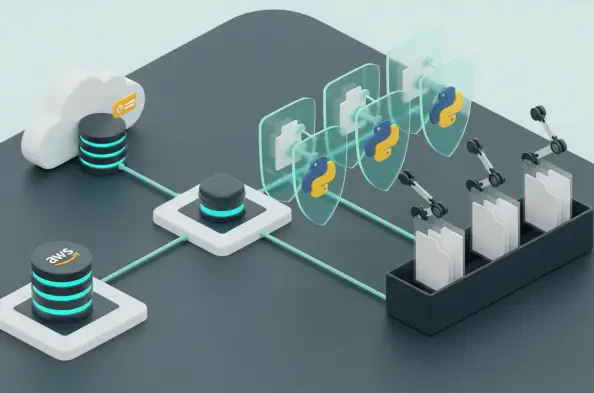
The initial stage of a secure data lifecycle requires capturing an accurate, point-in-time representation of the production environment without disrupting the live application’s performance. Within the AWS ecosystem, this is best achieved by triggering an automated snapshot of the Amazon RDS or Aurora instances. This process creates a storage-level backup that includes all schemas, tables, and records exactly as they exist at that specific moment. By using a snapshot rather than a series of live SQL queries, the system avoids placing an unnecessary read load on the production primary, which prevents potential latency issues for end-users. This snapshot serves as the “source of truth” for the masking pipeline, ensuring that the development and testing teams are working with data that reflects the current state of the application, including the latest schema migrations and data distributions.
Once the snapshot is initiated, it exists as a managed resource within the AWS console, isolated from the public internet and restricted by tight Identity and Access Management (IAM) policies. The automation script monitors the snapshot’s progress, waiting for the status to change to “available” before proceeding to the next phase. This isolation is critical because it ensures that even if a breach were to occur in the development network, the raw production data remains protected within the production account’s management layer. Furthermore, the use of point-in-time recovery (PITR) features allows the pipeline to specify an exact timestamp, which is particularly useful for debugging specific incidents that occurred in production. This level of precision is fundamental for creating a staging environment that is not just a general approximation of reality, but a mathematically and structurally accurate twin of the live environment, minus the actual sensitive details.
2. Move the Snapshot Data as CSV Files into a Highly Restricted S3 Bucket
After the snapshot is fully provisioned, the next logical step is to extract the tabular data into a format that is conducive to high-speed processing and manipulation. Converting the snapshot into CSV files and storing them in an Amazon S3 bucket serves multiple purposes. First, the CSV format is essentially agnostic, allowing various tools and scripts to parse the data without requiring a persistent connection to a live database engine. This reduces the infrastructure overhead and costs associated with running a dedicated “temporary” database for the masking process. Second, S3 provides a robust, policy-driven landing zone where data can be stored with encryption at rest using AWS Key Management Service (KMS). By directing these files into a highly restricted bucket, the organization can enforce a “deny-by-default” policy, ensuring that only the specific masking service has the permission to read the raw data files.
This intermediate storage phase acts as a security buffer, preventing the direct transfer of unmasked data between different database instances across various accounts. The transition from a database snapshot to a flat-file structure also allows for granular control over exactly which datasets are being moved. For instance, the pipeline can be configured to exclude specific tables that are known to contain strictly internal metadata or high-risk financial records that are not necessary for the testing process. This practice of data minimization is a core tenet of modern privacy frameworks. By only exporting the necessary columns and rows into the restricted S3 bucket, the pipeline reduces the overall data footprint, which in turn simplifies the auditing process and minimizes the potential impact of any unauthorized access during the brief window that the raw data exists outside the primary database.
3. Execute the Python Anonymization Script on a Private Runner inside the Secure Network
The core of the masking operation takes place within an isolated execution environment, typically a private runner or a containerized worker located inside a secure Virtual Private Cloud (VPC). Here, a specialized Python script is deployed to process the CSV files stored in the restricted S3 bucket. This script functions as the masking engine, employing libraries such as Pandas or Dask to handle large datasets efficiently. The primary objective of this script is to replace PII with realistic but fictional alternatives or to apply cryptographic transformations. One of the most effective techniques used here is deterministic hashing. By using a consistent salt and a secure hashing algorithm like SHA-256, the engine can replace a value—such as a user’s email address—with a unique, consistent string. This ensures that if the same email appears in multiple tables, it is replaced by the same hash everywhere, thus maintaining the referential integrity of the database.
Beyond simple hashing, the Python script can also utilize data generation libraries to replace names, phone numbers, and physical addresses with “fake” data that maintains the correct format and distribution. This is essential for testing features like address validation or SMS notification systems in the staging environment. Because the script runs on a private runner within a locked-down network segment, the data never traverses the open internet during the transformation process. The script is designed to be stateless, pulling a chunk of data, applying the transformation logic, and then passing the result to the next stage. This prevents the sensitive data from being cached or stored permanently on the runner’s local disk. By centralizing the masking logic in a single, version-controlled Python script, the security team can easily update masking rules as new types of PII are added to the application schema, ensuring that the pipeline remains resilient to change.
4. Transfer the Sanitized CSV Files to the S3 Bucket Designated for Staging
Once the Python engine has successfully obscured all sensitive information, the resulting “clean” CSV files are ready for distribution. The pipeline moves these sanitized assets to a separate S3 bucket specifically designated for the staging environment. This transfer is more than just a simple file move; it represents the crossing of a security boundary from a high-trust, high-restriction zone to a lower-trust, collaborative zone. The staging bucket is configured to allow access from the staging VPC, where developers and automated testing tools can ingest the data. Because the data has already been masked, the risk associated with this broader access is virtually eliminated. The files in the staging bucket provide a “ready-to-use” dataset that can be loaded into staging databases, utilized for analytics testing, or fed into machine learning models without any fear of exposing real customer identities.
The availability of sanitized data in the staging S3 bucket facilitates a “self-service” model for development teams. Instead of waiting for a manual data refresh, teams can trigger an automated job that pulls the latest sanitized CSVs and hydrates their local or shared testing databases. This significantly increases developer velocity, as teams are no longer blocked by outdated or incomplete test data. Furthermore, because the transfer process is automated through the pipeline, there is a clear audit trail showing exactly when the data was moved and verifying that the masking script was executed successfully prior to the transfer. This transparency is vital for demonstrating compliance with internal security policies. The sanitized files act as a bridge, providing the realism of production data with the safety of a synthetic environment, allowing for rigorous testing of performance, scalability, and complex business logic in a secure manner.
5. Clear the Original Sensitive CSVs from the Secure Storage Bucket
The final, yet perhaps most critical, step in the automated lifecycle is the systematic deletion of the raw, unmasked data from the intermediate storage locations. After the sanitized files have been confirmed as successfully transferred to the staging bucket, the pipeline triggers a cleanup routine that wipes the original sensitive CSVs from the restricted S3 bucket. This process is often managed through a combination of lifecycle policies and explicit API calls within the automation script. The goal is to ensure that the window of time in which the raw data exists in a flat-file format is kept to the absolute minimum. By programmatically deleting these files, the system adheres to the principle of ephemeral storage, where sensitive data is only kept for as long as is strictly necessary to complete its intended transformation.
This automated cleanup is a powerful defense against “data rot,” where forgotten copies of sensitive information accumulate in various storage pockets over time. In a manual workflow, it is easy for an administrator to forget to delete a temporary export, but an automated pipeline never forgets. Additionally, the cleanup process includes the termination of any temporary compute resources used during the masking phase, such as the private runners or temporary database instances. The system logs the successful deletion of these assets, providing documented evidence that the unmasked data has been purged from the intermediate zone. This closing of the loop ensures that the organization’s total data liability does not increase with every refresh of the staging environment. It solidifies the pipeline as a secure, end-to-end workflow that respects the privacy of the original data while still delivering the necessary value to the engineering organization.
The implementation of an automated masking pipeline represented a fundamental shift in how the organization approached data sovereignty and privacy. By integrating these five critical steps into a cohesive lifecycle, the engineering department successfully eliminated the manual handling of sensitive production records, thereby closing a primary vector for potential data breaches. This methodical approach not only satisfied the requirements of modern data protection laws but also empowered development teams with high-quality, realistic datasets that accurately reflected production scenarios without the inherent risks. Looking back, the transition toward a “privacy by design” infrastructure proved that security does not have to be a bottleneck for innovation; instead, it served as a catalyst for building more resilient software. As storage and processing costs continued to decrease, the feasibility of maintaining ephemeral, sanitized data environments became the gold standard for industry leaders. Moving forward, the focus will likely shift toward even more granular synthetic data generation, yet the foundational principles of isolation and deterministic masking established in this framework will remain essential for any organization handling sensitive information.