Relying on historical model reuse rather than redundant training cycles significantly accelerates the pipeline for modern data transport challenges. As industrial ecosystems increasingly depend on sprawling networks of interconnected sensors, the volume of time-series data generated by these devices has begun to outpace the growth of available network bandwidth. This mismatch creates a critical bottleneck, where the traditional approach of transmitting every raw data point is no longer feasible. While earlier “sample-then-generate” frameworks attempted to mitigate this by only sending small data fragments and reconstructing them later in the cloud, they frequently encountered issues with operational latency. The primary culprit was the necessity for constant online retraining of generative models to account for shifting data patterns. This continuous training loop consumed valuable computational resources, necessitating a more refined approach that prioritizes speed and structural efficiency in data recovery.
Shifting Paradigms: From Retraining to Retrieval
Minimizing Latency: Overcoming Online Learning Hurdles
The evolution of the Xender+ framework marks a departure from the resource-heavy requirements of previous systems by emphasizing retrieval over repeated training. In traditional IoT setups, each new wave of incoming data often triggered a new training cycle for deep learning models to ensure that the reconstructed data matched the original characteristics. However, this method proved to be a major hindrance in real-time applications where every second of delay could lead to missed anomalies or delayed responses, especially in sectors like healthcare or power grid management.
By pivoting toward model reuse, the system identifies that many data patterns in the physical world are recurring. Instead of building a new mathematical representation from scratch, the architecture now looks for existing models that have already mastered similar data behaviors. This shift significantly reduces the end-to-end latency that once plagued generative data transmission, allowing for a much faster transition from raw sensor output to usable cloud-side information.
Intelligent Libraries: Dynamic Management and Scalability
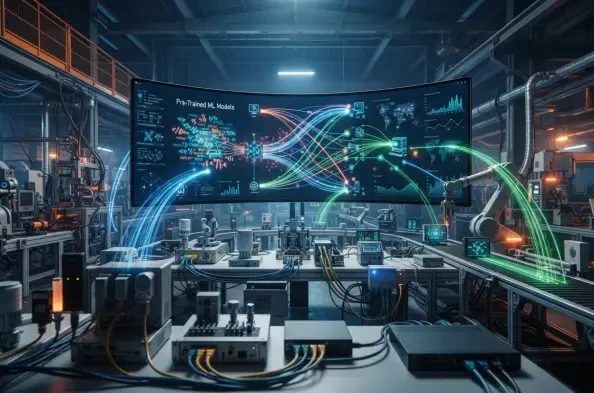
To facilitate this, the system employs a library of pre-trained TDGen models organized into clusters based on their specific data-capture capabilities. These clusters represent various historical trends encountered across diverse deployments, such as temperature fluctuations or vibration patterns. When a sampled data segment arrives, the cloud-side logic performs a similarity check to find a compatible model. This transforms the reconstruction phase from a learning task into a streamlined matching exercise, maintaining high fidelity without the overhead of optimization.
Furthermore, the framework incorporates a dynamic cluster expansion mechanism to handle unforeseen data patterns. When incoming data fails to find a suitable match, the system initiates a targeted training session to create a new model instance. To maintain efficiency, an LRU eviction policy removes outdated models that have not been used recently. This ensures that the library remains lean and optimized for rapid retrieval, preventing the system from becoming bloated as the network scales.
Streamlining Pipelines: The Edge-to-Cloud Connection
Hardware Integration: Advanced Acceleration at the Source
The efficiency of the pipeline is not solely dependent on the cloud; it begins with how data is handled at the source. Modern edge devices are now equipped with powerful processing units that can be leveraged to reduce the initial computational burden. By integrating a GPU-accelerated sampling algorithm directly onto the edge hardware, the time required to prepare data for transmission is drastically shortened. This allows for complex sampling strategies that better preserve essential features of the original time-series data while minimizing the energy consumed during transmission.
Comprehensive testing against established baselines has demonstrated that this holistic approach to pipeline optimization yields superior results. The interaction between the edge and the cloud ensures that the sampling rate is dynamically adjusted based on data complexity. By combining edge-side hardware acceleration with the historical model reuse framework, the total end-to-end latency was reduced by a significant margin. This success highlights the importance of the entire lifecycle.
Practical Outcomes: Strategic Implementation and Insights
Adopting model-reuse strategies offers a sustainable path for smart city infrastructure and large-scale industrial IoT. The ability to minimize data transmission while maintaining high reconstruction quality translates to lower energy consumption and reduced operational costs. As urban environments become more saturated with connected devices, these optimization techniques will be indispensable for maintaining service reliability. Developers must focus on building modular libraries to maximize the utility of pre-trained models across different sectors and diverse deployments.
In conclusion, the implementation of Xender+ demonstrated that historical model reuse was a more viable strategy than continuous retraining. The framework utilized GPU acceleration at the edge to streamline the initial sampling process, while cloud-side management ensured the system remained adaptive. These advancements allowed for a significant reduction in latency without sacrificing accuracy. Moving forward, the focus shifted toward integrating these methodologies into broader computing standards.