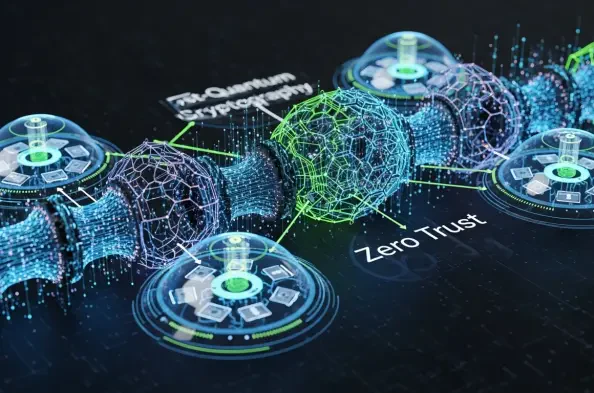
The relentless progression of quantum computing has officially rendered traditional encryption methods obsolete, forcing a total paradigm shift in how global enterprises secure their most sensitive data within a zero trust framework. For years, the cybersecurity community treated the quantum threat as a distant concern, yet the reality of 2026 shows that the window for migration has narrowed significantly for those lagging behind. Zero trust architectures, which rely heavily on the principle of ‘never trust, always verify,’ are inherently dependent on the strength of the underlying cryptographic protocols that authenticate identities and encrypt communications. If the fundamental mathematics protecting these interactions can be broken by a quantum processor, the entire zero trust model collapses into a state of perpetual vulnerability. Consequently, organizations are prioritizing the integration of post-quantum cryptography to ensure that identity-based access controls remain resilient against computational threats that bypass legacy standards.
Redefining Verification With Quantum-Resistant Standards
Strengthening Identity and Access Management
Within the current landscape, the integrity of identity and access management serves as the primary gatekeeper for organizational resources, yet these systems face unprecedented risks from quantum-enabled decryption. Legacy public-key infrastructures that once provided a secure foundation for digital signatures and certificates are no longer sufficient to guarantee the authenticity of a user or device. By implementing lattice-based cryptographic algorithms, such as ML-KEM and ML-DSA, security architects are successfully reinforcing the verification layer of zero trust environments. These new standards ensure that even if an adversary intercepts authentication traffic today, the encrypted tokens and credentials will remain secure against future quantum analysis. This shift is not merely a software update but a fundamental re-engineering of the trust anchors that define modern networking. Without these quantum-resistant signatures, the ‘verify’ part of zero trust becomes a meaningless gesture, as spoofing identities becomes trivial for those possessing advanced hardware.
Protecting Data in Motion and at Rest
The protection of data as it traverses increasingly fragmented network boundaries represents another critical area where post-quantum cryptography provides the necessary durability for zero trust policies. As employees access cloud-native applications from unmanaged locations, the reliance on secure tunnels like TLS and VPNs has reached an all-time high. Modern implementations are now utilizing hybrid cryptographic schemes that combine classical and quantum-resistant algorithms to provide a safety net during this transitional period. This approach ensures that data in motion is shielded from immediate classical threats while preparing the infrastructure for a full transition to post-quantum standards. Furthermore, the concern over ‘harvest now, decrypt later’ strategies employed by persistent threat actors has made PQC integration for data at rest a mandatory requirement. By securing stored archives with algorithms that resist Shor’s algorithm, enterprises are effectively neutralizing the long-term value of stolen data, ensuring that information remains confidential for decades.
Strategic Implementation and Future Resilience
Achieving True Crypto-Agility
Maintaining a zero trust posture requires a level of crypto-agility that was previously considered optional but has now become a central tenet of operational resilience. Crypto-agility refers to the capacity of an IT environment to rapidly replace cryptographic primitives without necessitating a complete overhaul of the underlying infrastructure or causing significant downtime. In the context of the current shift, this means that security teams must be able to swap out vulnerable algorithms for more robust post-quantum alternatives as new vulnerabilities are discovered or as hardware capabilities evolve. This adaptability is vital because the mathematical foundations of some early PQC candidates are still being rigorously tested in real-world scenarios. Organizations that have built their zero trust frameworks on modular cryptographic layers are finding it much easier to stay ahead of the curve. They can update security protocols as easily as a typical software patch, which prevents vendor lock-in and ensures that security remains dynamic and responsive to the latest intelligence.
Proactive Defense: The Path Forward
The integration of post-quantum cryptography into the zero trust model proved to be the only viable path for ensuring long-term data sovereignty and organizational integrity. Leaders who recognized the urgency of the quantum threat early on successfully inventoried their cryptographic assets and prioritized the migration of high-value systems. These early adopters moved beyond mere compliance and established a culture of proactive defense, where security was viewed as an evolving discipline rather than a static checkbox. The transition involved rigorous testing of new protocols within existing workflows to minimize latency and ensure compatibility across diverse environments. By moving toward a standardized PQC framework, the industry collectively strengthened the defense against state-sponsored actors and sophisticated cybercriminals. Future security strategies focused on the importance of visibility into all encrypted traffic and the continuous monitoring of cryptographic health. This proactive stance ensured that the digital economy remained resilient even as computing power reached once-unimaginable levels.