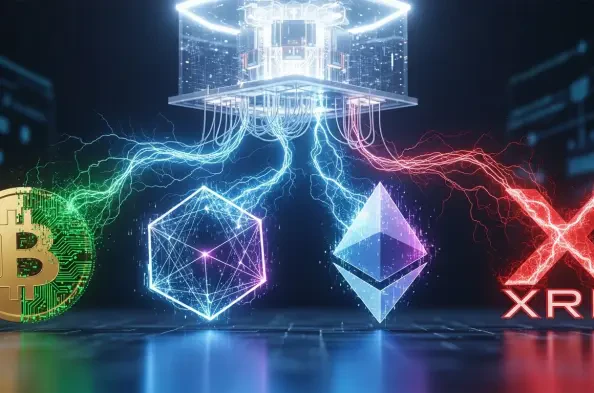
The sudden realization that a single computational breakthrough could potentially dismantle the multi-trillion-dollar cryptographic landscape has shifted from a theoretical curiosity into an urgent engineering priority for 2026. As quantum hardware continues to scale toward the thresholds required to run Shor’s algorithm, the foundational security of digital assets is being scrutinized with unprecedented intensity by researchers and developers alike. This algorithm presents a direct threat to the Elliptic Curve Digital Signature Algorithm (ECDSA) and RSA standards that currently safeguard nearly every wallet and smart contract in existence. While the industry has long relied on the mathematical difficulty of factoring large numbers or solving discrete logarithms, the arrival of sufficiently powerful quantum processors threatens to render these defenses obsolete. This transition period demands a deep dive into how various blockchain architectures are positioned to withstand a transition that will redefine digital sovereignty for the remainder of the decade.
Structural Vulnerabilities in Decentralized Networks
Bitcoin and the Threat to Legacy Addresses
Bitcoin faces a particularly grueling challenge due to its rigid commitment to backward compatibility and the existence of vast amounts of “dormant” capital. The primary concern lies in the way Bitcoin historically managed public keys; many early addresses, including the legendary holdings of Satoshi Nakamoto, have their public keys exposed directly on the blockchain. When a user spends Bitcoin, the public key is revealed to the network, and in the case of older P2PK (Pay-to-Public-Key) transactions, that information is already visible. A quantum adversary could theoretically use Shor’s algorithm to derive the private key from these exposed public keys, effectively draining billions of dollars in value without the owners ever being able to intervene. Because these coins are essentially “lost” or inactive, the community faces a philosophical schism: whether to allow the theft of these assets or to implement a controversial soft fork that would burn or move them to a new, quantum-safe standard.
Beyond the immediate risk to inactive wallets, the very process of a Bitcoin transaction creates a window of vulnerability during the mempool phase. When a user broadcasts a transaction today, the public key is revealed to the network while the transaction waits to be included in a block by miners. In a world with high-speed quantum computers, an attacker could potentially intercept this broadcast, compute the private key in seconds, and craft a competing transaction with a higher fee to redirect the funds to their own address. This “front-running” attack would effectively break the trust in Bitcoin’s ability to process secure payments. While developers are researching Taproot-compatible post-quantum signatures like Winternitz One-Time Signatures (WOTS), the logistical hurdle of migrating millions of active users to new address formats without losing funds in the process remains one of the most significant technical debt challenges the network has ever encountered in its history.
Complexity and Attack Surfaces in Ethereum
Ethereum presents a different but equally complex risk profile because its ecosystem is far more expansive than a simple value-transfer ledger. The network is currently the foundational layer for decentralized finance (DeFi), non-fungible tokens (NFTs), and various Layer-2 scaling solutions, all of which rely on the same underlying cryptographic primitives. If the primary signature scheme is compromised, the entire web of interconnected smart contracts could collapse like a house of cards. For instance, a quantum-capable attacker would not just target individual wallets; they could target the liquidity pools of major decentralized exchanges, the collateral in lending protocols, or the administrative keys of bridge contracts. The sheer density of value locked in these complex scripts makes Ethereum a highly attractive target for a sophisticated adversary, as a single successful breach could yield a systemic failure across the entire decentralized economy.
Despite these risks, the Ethereum community has historically demonstrated a high degree of agility when it comes to network-wide upgrades, often referred to as “hard forks.” Vitalik Buterin and the Ethereum Foundation have already proposed a “quantum emergency” plan that involves a rapid transition to a new hash-based signature scheme. This plan would likely involve a network state transition where every account must be “wrapped” or migrated into a quantum-proof container. However, the migration of the Proof-of-Stake (PoS) consensus mechanism is another layer of difficulty. The validators who secure the network use BLS signatures to aggregate their votes; if these signatures are cracked, an attacker could forge the consensus of the entire chain. Therefore, Ethereum must simultaneously solve the problem of quantum-proofing its user-level assets and its underlying consensus layer, a task that requires a complete overhaul of the network’s core cryptographic engine within the 2026-2028 timeframe.
Architectural Resilience and Network Evolution
XRP Ledger and Controlled Upgradability
The XRP Ledger (XRPL) is often cited as having a distinct advantage in a post-quantum world due to its unique consensus mechanism and streamlined architectural design. Unlike Bitcoin or Ethereum, XRPL does not rely on mining or traditional Proof-of-Stake, instead using a Federated Consensus model where a set of trusted validators agrees on the state of the ledger. This structure allows for much faster transaction finality, often occurring in three to five seconds. For a quantum attacker attempting to perform a front-running attack during the transaction broadcast phase, this incredibly narrow window makes it nearly impossible to compute a private key and submit a competing transaction in time. The speed of the network acts as a natural deterrent, providing a layer of “temporal security” that slower blockchains simply cannot match without major fundamental changes to their block times.
Furthermore, the XRPL was built with modularity in mind, specifically regarding its support for diverse cryptographic algorithms. The ledger already supports multiple signature types, such as Ed25519 and SECP256K1, and its design makes the addition of new, quantum-resistant algorithms relatively straightforward compared to its peers. Because the validator set is more coordinated than a massive, decentralized pool of anonymous miners, the network can implement and reach consensus on critical security upgrades with far less friction. This agility is crucial when dealing with an emergent threat like quantum computing, where the window between a theoretical risk and a practical exploit could be surprisingly small. The ability to pivot quickly to NewHope or Crystals-Kyber standards ensures that XRP remains a more stable environment for institutional settlement, which is the primary use case for the digital asset in the current global financial ecosystem.
Strategic Implementation of Post-Quantum Standards
The transition to a quantum-secure environment requires more than just new algorithms; it necessitates a total shift in how digital identity and ownership are managed on the blockchain. Future-proofing these networks involves the integration of lattice-based cryptography, which is currently believed to be resistant to both classical and quantum attacks. For Bitcoin and Ethereum, this means moving toward “zero-knowledge” proofs and hash-based signatures that do not rely on the difficulty of the discrete log problem. While these new signatures are often much larger in size—potentially increasing the storage requirements and transaction fees for users—the trade-off is a necessary insurance policy against the total loss of capital. We are seeing a trend where Layer-2 solutions are being used as testing grounds for these advanced cryptographic methods, allowing the main layers to remain stable while the new tech is refined in a live environment.
Ultimately, the path toward quantum resilience is a race against time and technological progress. It is no longer a question of “if” quantum computers will be able to break current encryption, but “when” and “how” the industry will respond. The most successful networks will be those that prioritize cryptographic flexibility and provide clear, automated pathways for users to migrate their funds. This involves developing user-friendly wallets that handle the complex task of rotating keys behind the scenes, ensuring that the average person does not need a degree in mathematics to keep their savings safe. As we move deeper into this decade, the distinction between secure and insecure assets will be defined by a network’s ability to shed its legacy vulnerabilities and embrace a new era of mathematical defense that can withstand the computational might of the quantum age.
The focus must now shift toward the practical execution of these cryptographic upgrades to ensure long-term sustainability for digital finance. Developers should prioritize the implementation of “hybrid” signature schemes, which combine current elliptic curve methods with emerging lattice-based protections to provide a safety net during the transition period. Asset holders are encouraged to move funds out of legacy P2PK addresses and into modern, hashed-address formats to mitigate the risk of public key exposure. Furthermore, organizations managing large treasuries should begin auditing their smart contract dependencies to identify any rigid cryptographic hard-coding that might prevent a smooth migration. By taking these proactive steps today, the blockchain industry can transform a potential existential crisis into an opportunity to build a more robust and permanent infrastructure for the global economy.