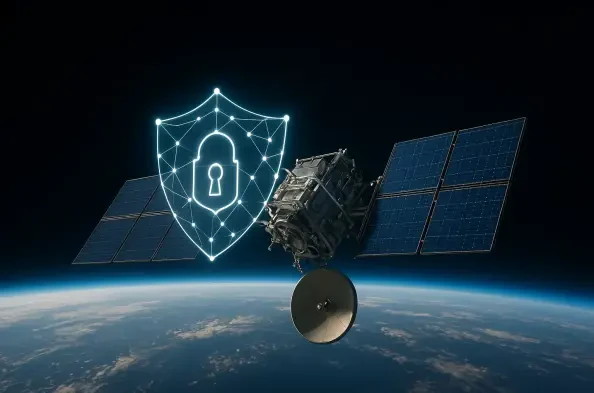
Because the modified weights remain within the original statistical range of the neural network, attackers cannot easily distinguish encrypted parameters from clean ones through analysis. This technical resilience is becoming increasingly vital as the orbital infrastructure in 2026 transitions toward a paradigm of decentralized intelligence and edge computing. Currently, the massive volume of data produced by Earth-observation constellations far outstrips the physical capacity of traditional downlink channels. Modern sensors can generate high-resolution multispectral imagery at rates exceeding tens of gigabits per second, but the radio and optical links that return this data to ground stations often struggle to maintain even a fraction of that throughput. Consequently, the aerospace industry has embraced on-orbit processing, where satellites use deep neural networks to analyze images locally and transmit only the most relevant insights. While this solved the bandwidth crisis, it created a significant security risk for the underlying AI models. These models represent millions of dollars in research and proprietary intellectual property, yet they must operate on hardware that is physically inaccessible and potentially shared by multiple third-party users in a constellation-as-a-service model. Protecting these assets without sacrificing the extreme efficiency required for space-based operations has become the primary challenge for the next generation of orbital missions.
Bridging the Gap: The Evolution of Orbital Security
Unified Protection: Merging Active and Passive Defense
A research team led by Hanwen Xu has introduced the STAR-OV framework to address the widening security gap in satellite AI deployments. Historically, protecting a neural network involved a choice between passive watermarking and active encryption, both of which had significant drawbacks in an orbital context. Watermarking techniques are useful for identifying a stolen model after a security breach has occurred, but they do nothing to prevent an unauthorized party from running the model in real time. Conversely, traditional encryption methods were typically binary, meaning a model was either completely locked or fully operational. This lack of flexibility made it difficult for satellite operators to offer tiered service levels or to maintain security across a shared hardware platform. STAR-OV changes this dynamic by unifying active access control and passive ownership verification into a single, cohesive architecture that allows for granular control over how and when a model functions.
The STAR-OV framework was developed specifically to handle the multi-tenant nature of modern satellite constellations where a single satellite might serve different clients with varying levels of authorization. By integrating these two traditionally separate defense strategies, the system provides a continuous security lifecycle that protects the model during its operational phase and offers legal recourse if the intellectual property is ever misappropriated. This approach allows developers to embed security directly into the structural weights of the network, rather than relying on external software wrappers that could be bypassed by a sophisticated attacker with direct access to the hardware’s memory. This strategic shift from external to internal protection ensures that the model remains secure even in the event of a total communication failure or unauthorized ground-station interception, providing a level of autonomy that is required for the long-term sustainability of the space economy.
Stratified Encryption: Precision Control of Performance
The core of the STAR-OV framework is its stratified encryption mechanism, which relies on a two-stage perturbation process to manage the accuracy of the neural network. Unlike standard encryption that might render a file unreadable, STAR-OV identifies a very small, high-impact subset of the model’s weights and shifts them just enough to degrade performance to a predetermined level. In the first stage, the framework applies a subtle nudge to specific parameters, reducing the model’s accuracy to a functional but lower-quality state. This allows operators to provide a “basic” tier of service where the model can still perform general tasks but lacks the high-precision capabilities required for critical applications. The second stage of encryption applies further perturbations, driving the model’s accuracy down to the level of random guessing, effectively rendering the model useless to any unauthorized user who does not possess the secondary decryption key.
This methodology is entirely reversible and relies on the exact mathematical coordinates of the weight modifications to serve as the decryption keys. When a legitimate user provides the correct key, the system restores the modified parameters to their original values with surgical precision, immediately returning the model to its peak performance. This flexibility is essential for satellite service providers who want to manage their assets dynamically without the overhead of uploading multiple versions of the same model. By using a single model that can be “tuned” into different security states, operators save significant storage space and transmission bandwidth. Furthermore, because the modifications are so sparse, the decryption process requires almost no computational power, which is a critical advantage for satellites operating in power-constrained environments. The ability to toggle between different performance tiers securely and efficiently represents a major advancement over the rigid encryption protocols used in earlier orbital missions.
Efficiency and Resilience: Operational Excellence in Space
Optimization: Managing Extreme Resource Constraints
Efficiency is perhaps the most impressive characteristic of the STAR-OV framework, as it was designed to function within the strict limits of satellite hardware. In rigorous testing, researchers demonstrated that the system could effectively control the performance of a model with over 23 million parameters by modifying fewer than 130 individual weights. This extreme sparsity means that the modification ratio is less than 0.001 percent of the total network structure, yet it is enough to fundamentally alter the model’s output quality. From a logistical standpoint, this tiny footprint translates into exceptionally small decryption keys that can be transmitted over even the narrowest and most congested satellite links. In an environment where every byte of uplink data is costly and every milliwatt of power is precious, the ability to maintain high-level security with such a minimal resource footprint is a game-changing development for long-duration space missions.
Beyond its physical footprint, STAR-OV is built to thrive in the low-precision arithmetic environments that are standard in modern space-grade edge processors. Satellites often use FP16 or FP8 data formats to reduce power consumption and heat generation, but many encryption methods suffer from numerical instability when moving away from standard FP32 precision. STAR-OV proved remarkably resilient to these constraints, maintaining the restored model’s accuracy within 0.3 percent of its original state even when operating in high-efficiency FP8 modes. Because the restoration process always calculates the weight shift from the encrypted baseline rather than building on previous decryptions, there is no risk of numerical errors accumulating over time. This stability ensures that the model remains reliable throughout its operational life, even as the satellite experiences radiation-induced memory effects or thermal fluctuations that can impact high-precision calculations in other systems.
Latent Watermarking: Silent Insurance for Owners
To complement its active encryption, STAR-OV incorporates a latent watermark that serves as a permanent, stealthy proof of ownership. Traditional watermarking techniques often involve creating a “backdoor” where the model is trained to misidentify specific trigger images. However, these traditional backdoors are often detectable by modern security scanners like Neural Cleanse, which look for anomalies in a model’s behavior. The STAR-OV watermark is unique because it remains completely dormant and undetectable until it is activated by a specific secret key. Without this activation, the model treats potential trigger images as standard data, leaving no statistical footprint for an attacker to find. Only when the original owner applies the watermark key do the weights shift into a state where the ownership trigger is recognized, allowing for definitive verification in the event of an intellectual property dispute.
The resilience of this latent watermark was a major focus during the development of the framework, as attackers often try to remove watermarks through techniques like fine-tuning or weight pruning. Fine-tuning involves retraining the model on new data to “wash away” the original owner’s signatures, while pruning removes the least important weights to compress the model. STAR-OV proved resistant to both; even after the model was pruned by 85 percent, the watermark remained intact and functional when activated. This level of durability ensures that the intellectual property remains protected throughout the entire lifecycle of the mission, from the initial deployment in 2026 to the end of the satellite’s functional life. This silent insurance policy provides developers with the confidence to deploy their most valuable algorithms in a global, shared space environment where physical control over the hardware is impossible to maintain.
Defensive Resilience: Countering Sophisticated Threats
Advanced Protection: Neutralizing Model Theft and Mimicry
The STAR-OV framework was designed to withstand a wide array of adversarial attacks, ranging from brute force attempts to sophisticated knowledge distillation. Brute force attacks, which involve guessing the location and value of encrypted weights, are rendered impossible by the astronomical number of potential parameter combinations within a modern neural network. Furthermore, the framework generates unique keys for every deployment, ensuring that a security breach on one satellite does not compromise the rest of the constellation. This “key uniqueness” is a critical feature for large-scale operations from 2026 to 2028, as it prevents localized failures from cascading into a fleet-wide security crisis. The researchers also ensured that users with partial access to intermediate performance tiers could not use gradient-guided optimization to “guess” their way to the full-performance model, effectively closing the door on privilege escalation attacks.
One of the most persistent threats to AI models is knowledge distillation, where an attacker trains a “student” model to mimic the predictions of a “teacher” model. If an attacker can query a model enough times, they can often build a functional copy without ever seeing the original weights. STAR-OV mitigates this risk by ensuring that an encrypted model only provides degraded or random data to unauthorized users. Any student model trained on this output would simply learn the degraded behavior, effectively “poisoning” the mimicry process. This multi-layered defense ensures that the model’s core intelligence remains a black box to everyone except those with the appropriate cryptographic authorization. By securing the model against both direct theft and indirect mimicry, the framework provides a comprehensive shield for the high-value intelligence that now drives the modern orbital economy.
Strategic Implementation: The Future of Secured Orbital Intelligence
As the space industry moves forward, the STAR-OV framework established a new standard for how AI assets are managed and protected beyond the atmosphere. The ability to provide tiered service levels without increasing the physical complexity of the onboard software allowed for more flexible and profitable business models in the satellite imaging sector. Operators began implementing these security protocols as a baseline requirement for any third-party AI software uploaded to their fleets. The small key size and low computational overhead meant that even legacy satellites with limited processing power could be updated to support the new security standard. This backward compatibility proved vital for maintaining a secure environment across hybrid constellations that mixed older hardware with the latest 2026-generation orbital platforms.
The successful deployment of this framework paved the way for more complex multi-national collaborations in space, where security and trust were previously major hurdles. With the assurance that intellectual property could be protected through stratified encryption and verified through latent watermarking, companies became more willing to share their most advanced algorithms for global environmental and security monitoring. Looking ahead, the focus of the research community shifted toward automating the management of these keys across massive constellations consisting of hundreds of individual nodes. By providing the necessary “locks” and “deeds” for orbital intelligence, STAR-OV ensured that the migration of AI to the final frontier remained both secure and commercially viable, ultimately fostering a more resilient and innovative space-based data ecosystem.